 Meet
 Email
 Slack
 WhatsApp
Evidence first
Canonical identities, invoice lineage, source timestamps, source-specific authority and explicit unknowns.
SYSTEMS ENGINEERING / INTERACTIVE REFERENCE
AI engineering translates operational requirements into coordinated systems of agents, tools and controls. The work begins by defining component responsibilities, data contracts and execution boundaries, then testing how the system handles normal operations, exceptions and recovery. The architectures and interactive walkthroughs below show how these decisions support reliable execution, traceability and human oversight.
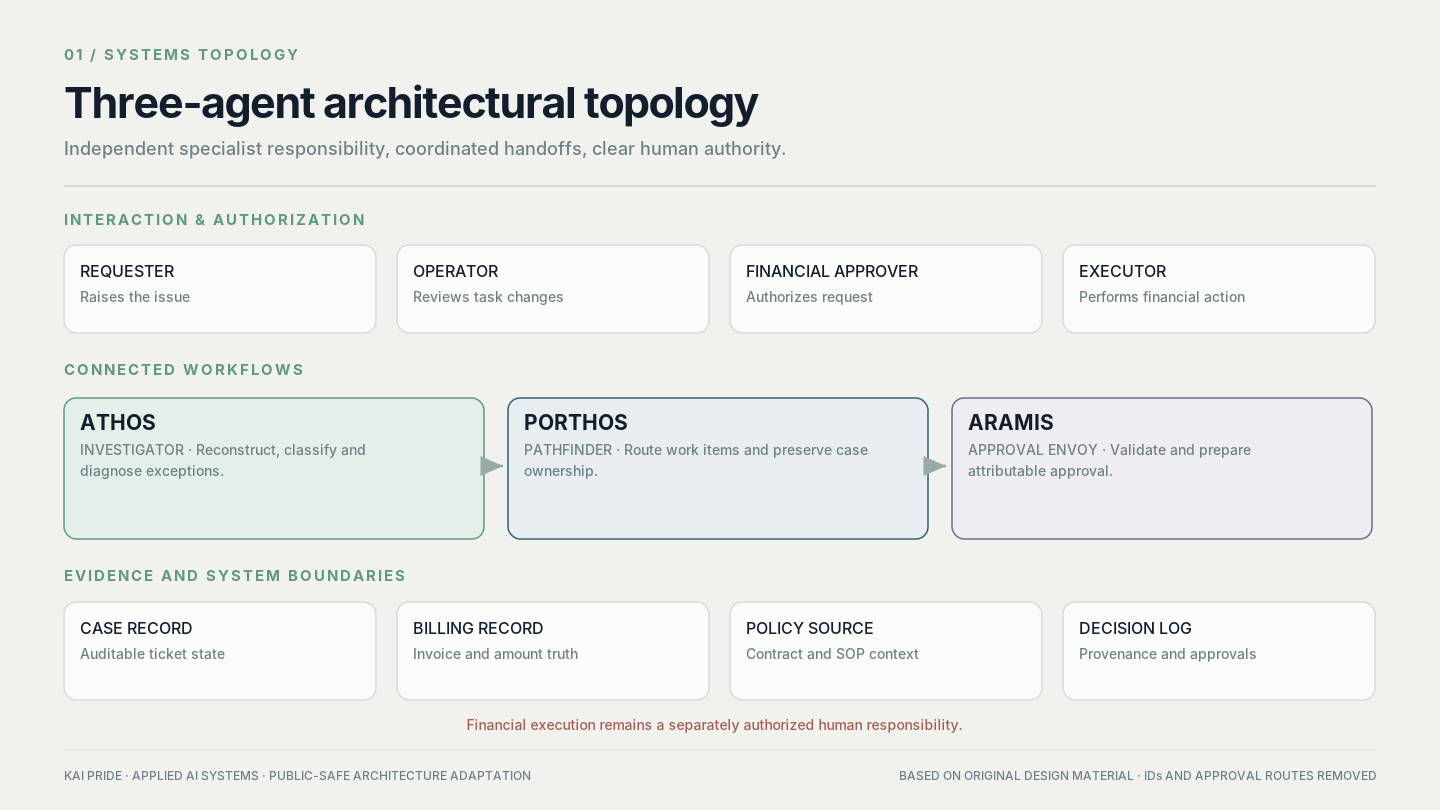
ATHOS provides a concrete example of this approach in accounts receivable investigation. Its modular architecture separates evidence retrieval, specialist analysis and deterministic financial checks, while versioned case state preserves the context passed between components. Explicit state transitions and approval gates define when an investigation can advance, when it must pause and which financial decisions require human authority.
EXPLORE THE PROPOSED AGENT TOPOLOGY
Authenticated case scope, case revisions, task budgets, source manifest and Purple reconciliation. Proposed parent architecture.
ATHOS workflow created as AR investigation and triage.
Activated workflow with specialist routing and human review.
Recorded workflow configuration and operating parameters.
Scoped specialists, Policy v2 patch, review protocol and proposed regression suite.
Canonical identities, invoice lineage, source timestamps, source-specific authority and explicit unknowns.
The ATHOS design specifies deterministic checks for amounts, thresholds, duplicate requests, rule conditions and workflow versions.
Investigation, approval preparation and actual financial execution remain separate responsibilities.
CASE STUDY / AGENTIC AUTOMATION CONTROL ARCHITECTURE
The original workflow map connects request intake, pre-flight checks, bounded execution, traceable outputs and independent post-generation auditing. The walkthrough below explains the controls at each stage.
ORIGINAL WORKFLOW MAP
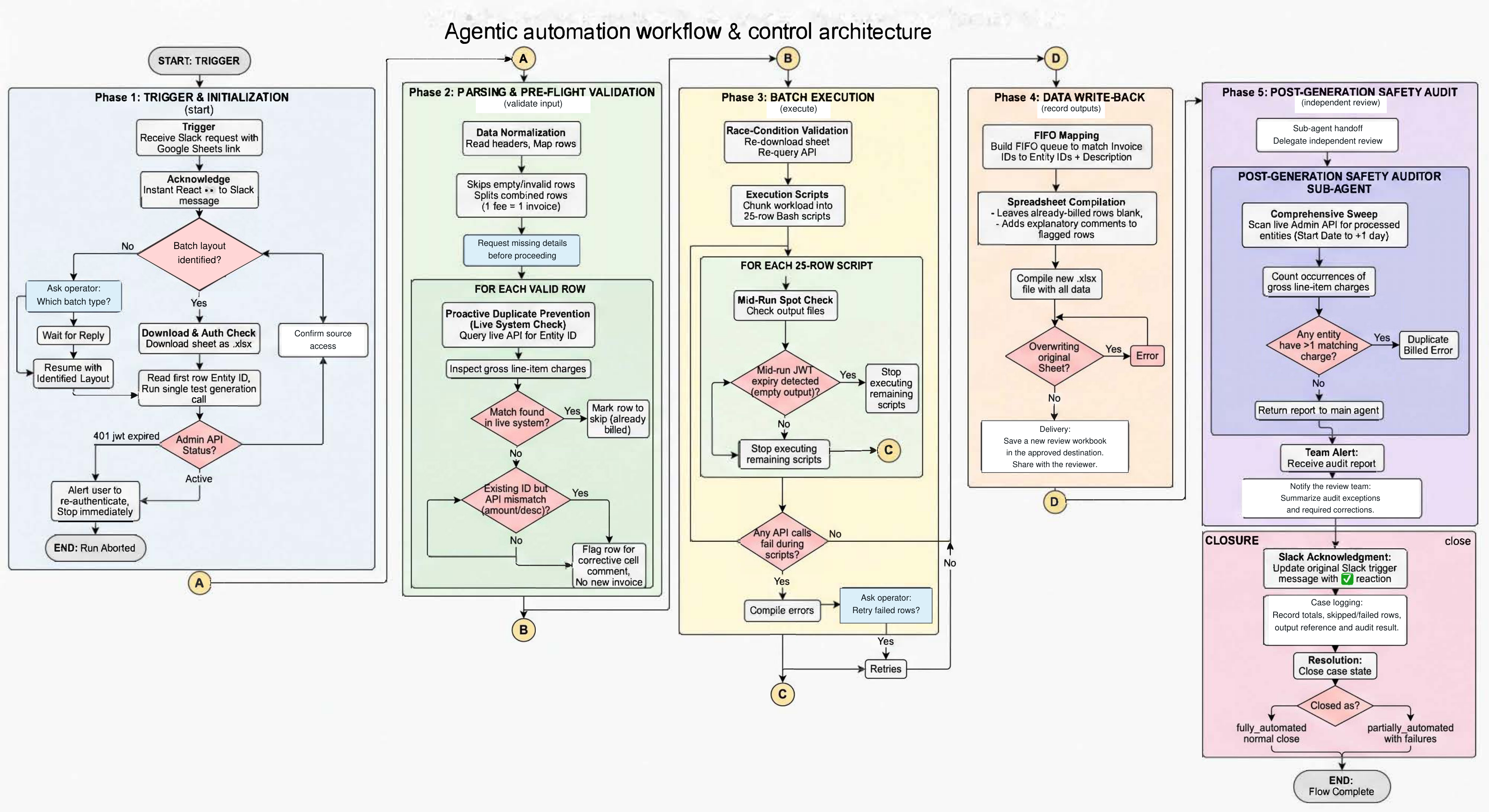
PHASE 01 / TRIGGER & INITIALIZATION
Validate the incoming request and source layout, confirm access and stop safely when authorization or required information is missing.
Authorization and input-schema checks before any financial operation.
Request clarification or re-authentication; abort rather than guessing.
ARCHITECTURE REVIEW / THREE-AGENT SYSTEM
ATHOS normalizes Slack and Workbench entry points, fans out queue items into individually tracked investigations, and resists embedded task instructions that impersonate the agent. PORTHOS applies structured routing precedence, with narrowly scoped exception handling. ARAMIS prepares and tracks human financial approvals. Case keys, explicit no-fit outcomes and human-gated status changes support controlled handoffs.
See the related operations intelligence design ↗Controlled monthly intake, deterministic calculator, FX reconciliation, versioned verification and explicit approval before final delivery.
Explore the original VENDOR workflow case study ↗Define the problem, assess the opportunities and plan a practical route to an applied AI or automation solution.