Applied AI & Automation Systems Architect. I turn complex commercial operations into intelligent, accountable systems—combining finance expertise, agentic workflow engineering and evidence-led design.
My work combines first-hand knowledge of billing, receivables, reconciliations and financial controls with hands-on agent architecture, testing, exception handling and evidence-led decision systems.
From investigation, task routing and approval preparation to billing automation, reconciliation and evidence analysis, my focus is consistent: build systems that are practical, traceable and accountable.
Bespoke Applied AI and automation services, grounded in industry experience and built around your business priorities. From operational review and solution architecture to implementation, launch and adoption, engagements combine end-to-end product ownership, phased delivery and measurable success criteria.
01 / REVIEW
Find the right problem to solve.
Engagements begin with a review of workflows, SOPs, data, tools and AI outputs to identify bottlenecks, failure points and automation opportunities. The resulting business case sets priorities, scope and success measures for time saved, error rates, review effort and adoption.
Standard Operating Procedures (SOPs) become Agentic Operating Procedures (AOPs): workflows with clear inputs, responsibilities, decision rules and escalation paths. AI agents, tool integrations, structured data contracts, deterministic calculations and human approvals make the work repeatable and reviewable.
Solutions are developed and refined through normal, exception and failure scenarios, tested against source records and agreed acceptance criteria. Focused pilots, phased rollout, monitoring, recovery procedures and team handover support a controlled transition into everyday use.
End-to-end product engagements connect discovery, requirements, roadmap priorities and technical delivery with launch readiness and go-to-market planning. The work includes positioning, product demonstrations, onboarding and adoption feedback, so the solution has a clear audience, purpose and path to improvement.
At Deel, I designed and built Applied AI workflows spanning investigation, task routing, approval preparation and monthly billing automation. I translated operational problems and SOPs into requirements, refined agent behaviour, validated calculations against source records and tested exception scenarios. That work combined finance expertise, technical implementation and independent review, with clear documentation and handovers across Billing Operations, Customer Success and Finance.
Available worldwide for applied AI consulting, workflow reviews, automation delivery and end-to-end product engagements.
INDUSTRY EXPERIENCE
Finance operator. Systems architect.
British-Canadian, with professional experience spanning the United States, Canada, the United Kingdom and Europe across technology, global employment services, consumer products and international media. This experience connects commercial requirements with practical systems architecture and accountable delivery.
I build because I believe technology should serve people—not the other way around. Whether I am investigating a billing exception or designing an agentic workflow, my aim is to leave the process safer, simpler and more useful than I found it.
At Meta, I worked with engineers and procurement colleagues to resolve invoice and purchase-order exceptions. That experience still shapes my first design question. When a number looks wrong, can the person responsible trace it to the agreement, understand what happened and decide what to do next?
Where do I start?
In a bank-file billing review, our team found that a payment-method field was being used to infer pricing eligibility. I proposed working backwards from accepted charges, false positives and exclusions to see where that assumption broke. Before I automate a rule, I want to know which record actually determines the answer.
What earns trust?
While investigating duplicate invoices, I found that the agent’s explanation did not fit the invoice timestamps. Reconstructing the sequence showed that a rerun could create an invoice that already existed. I added a check for an existing invoice before creation. Since then, I verify completion against the record the workflow was meant to change.
What should an agent decide?
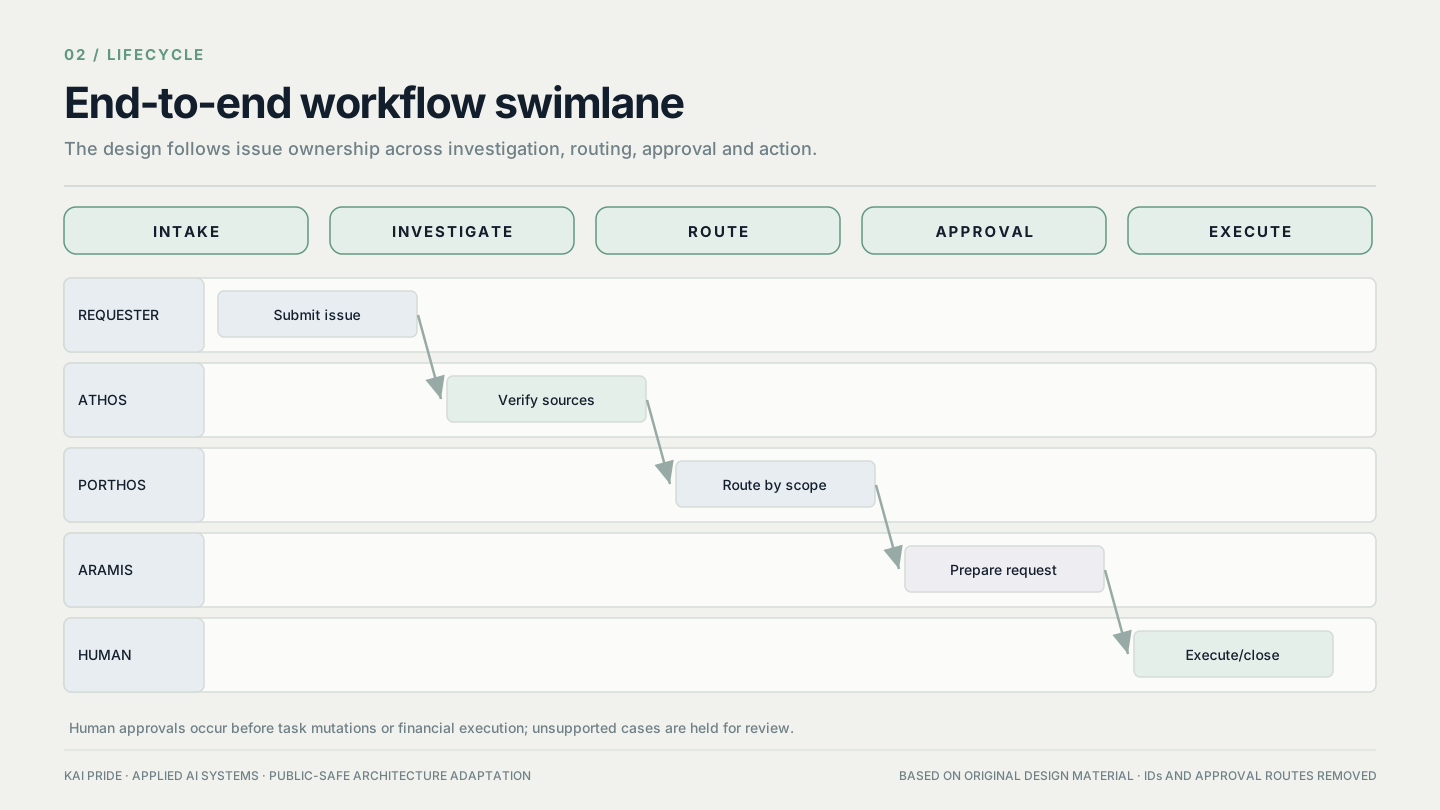
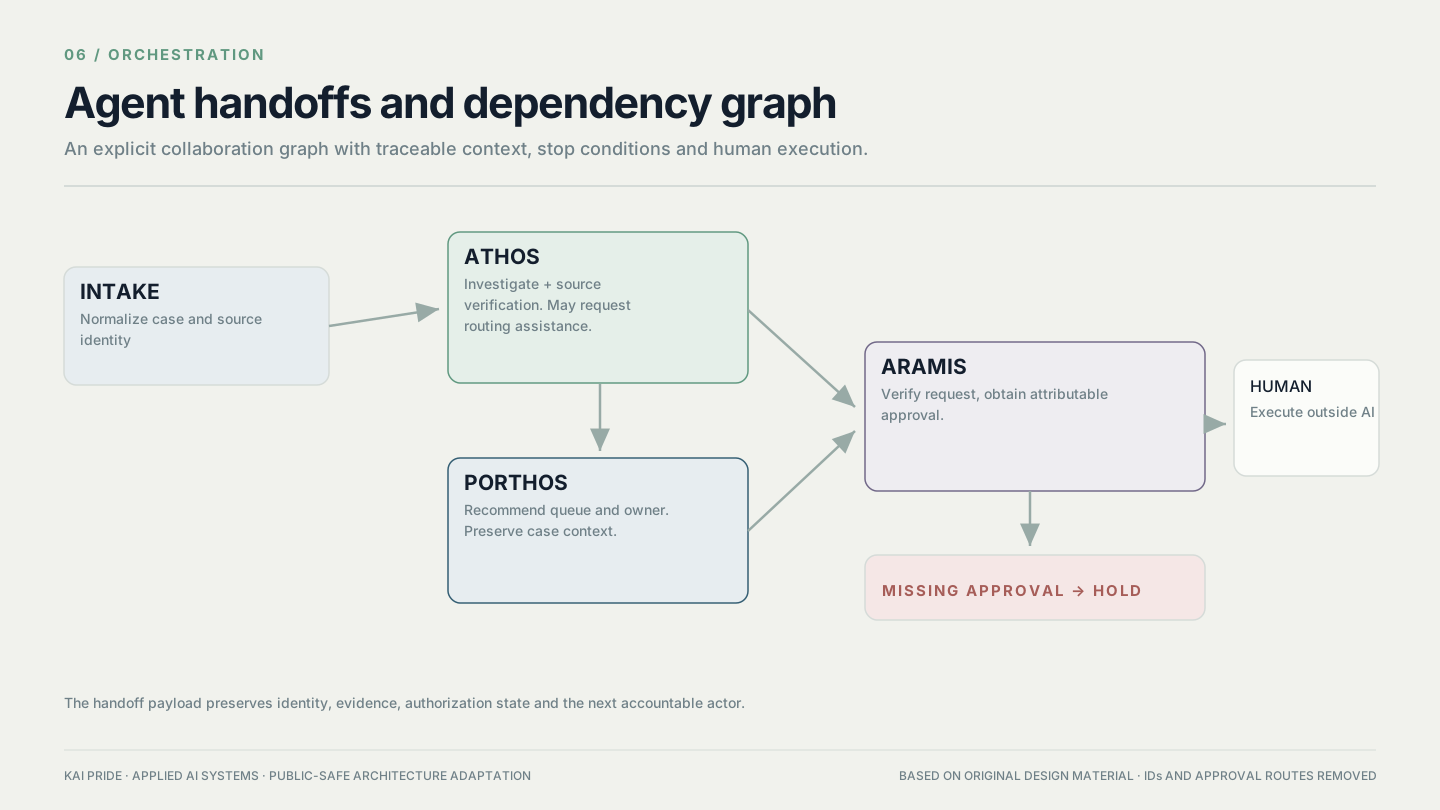
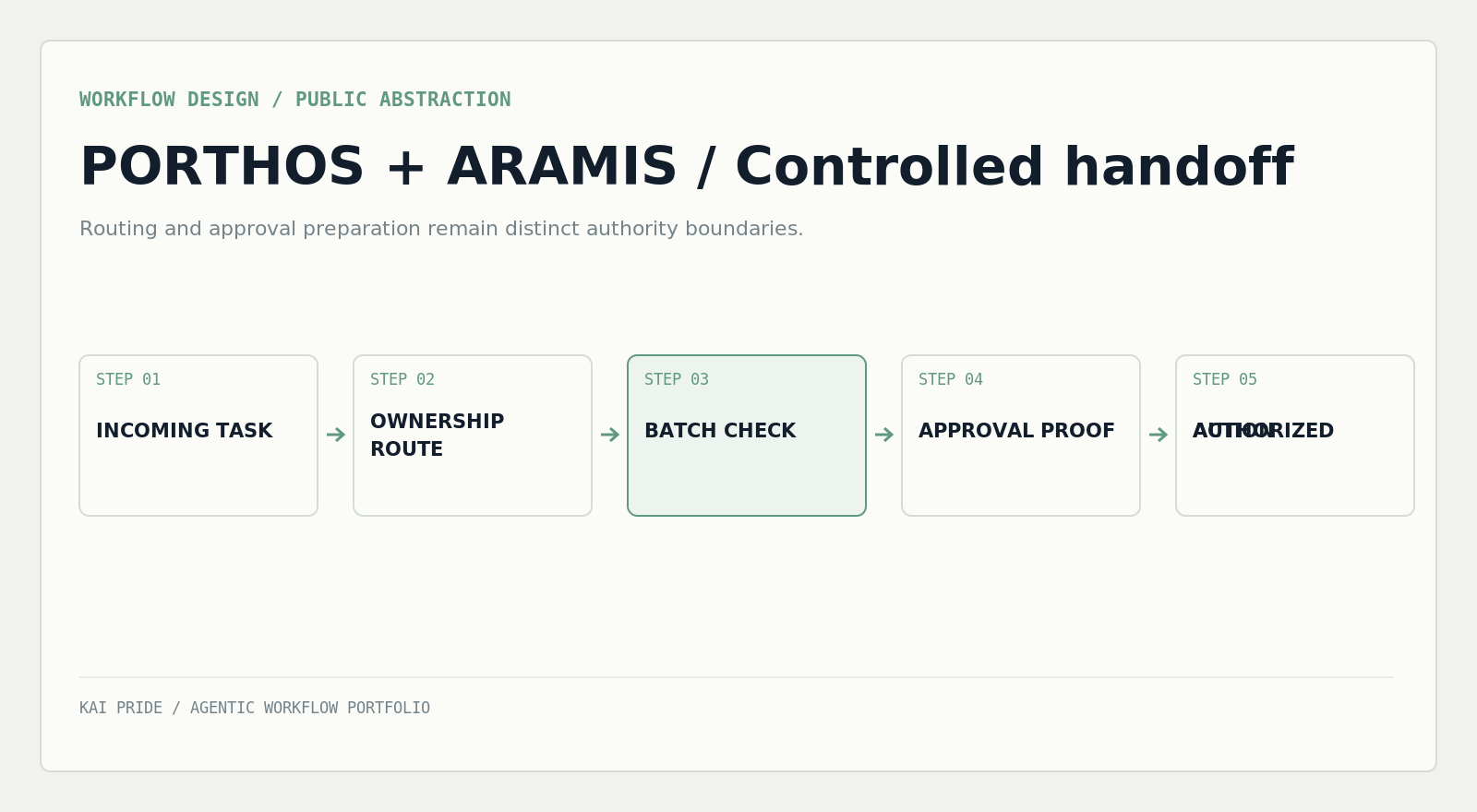
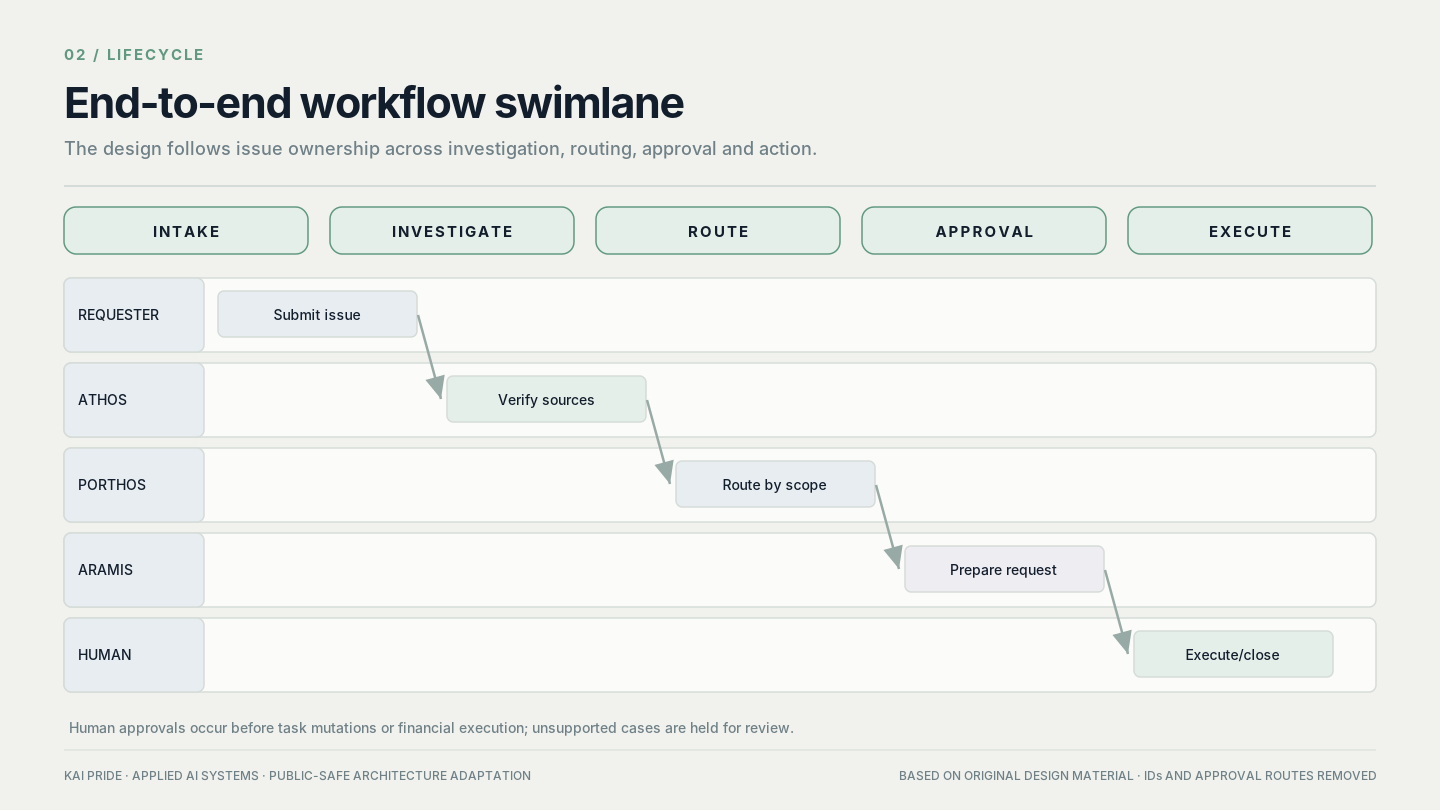
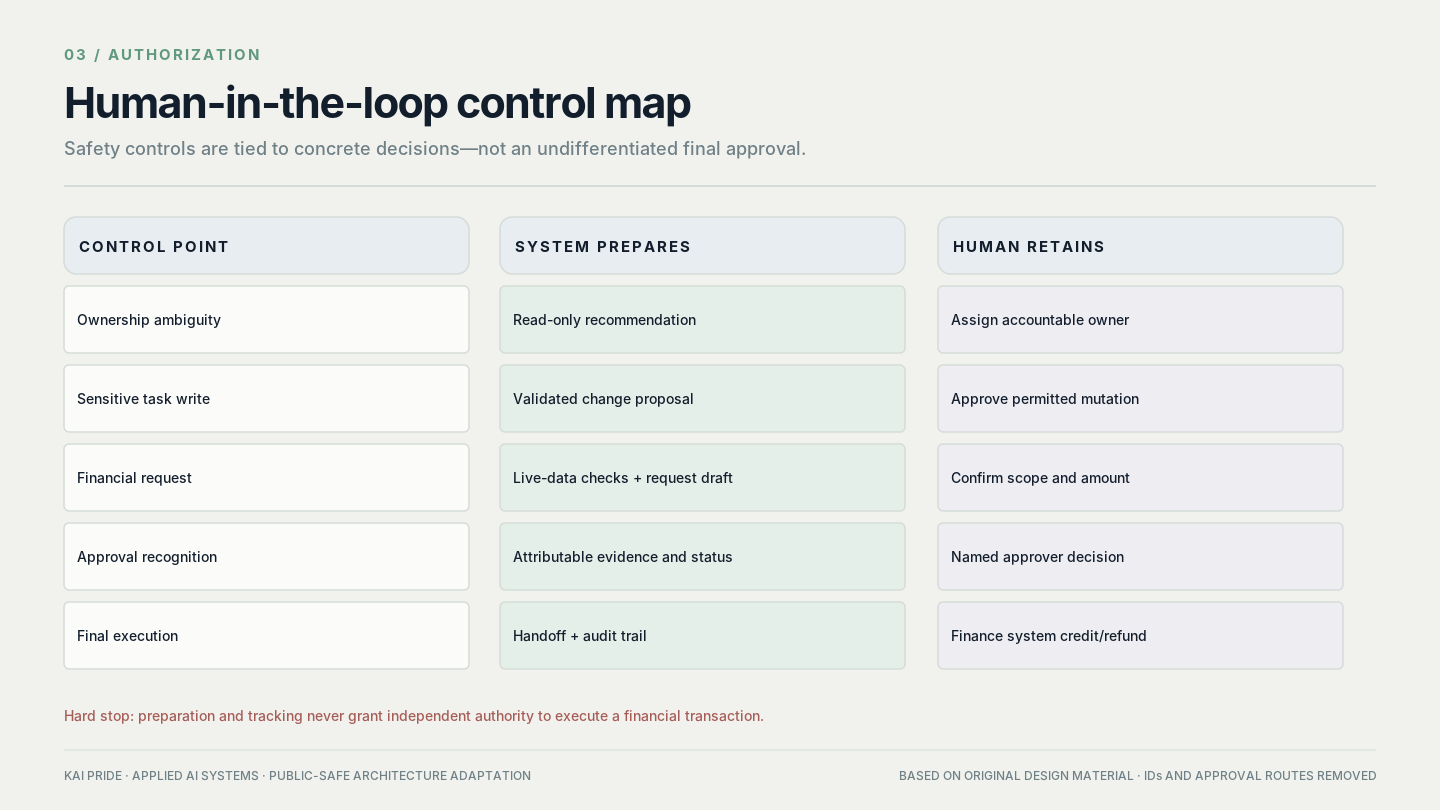
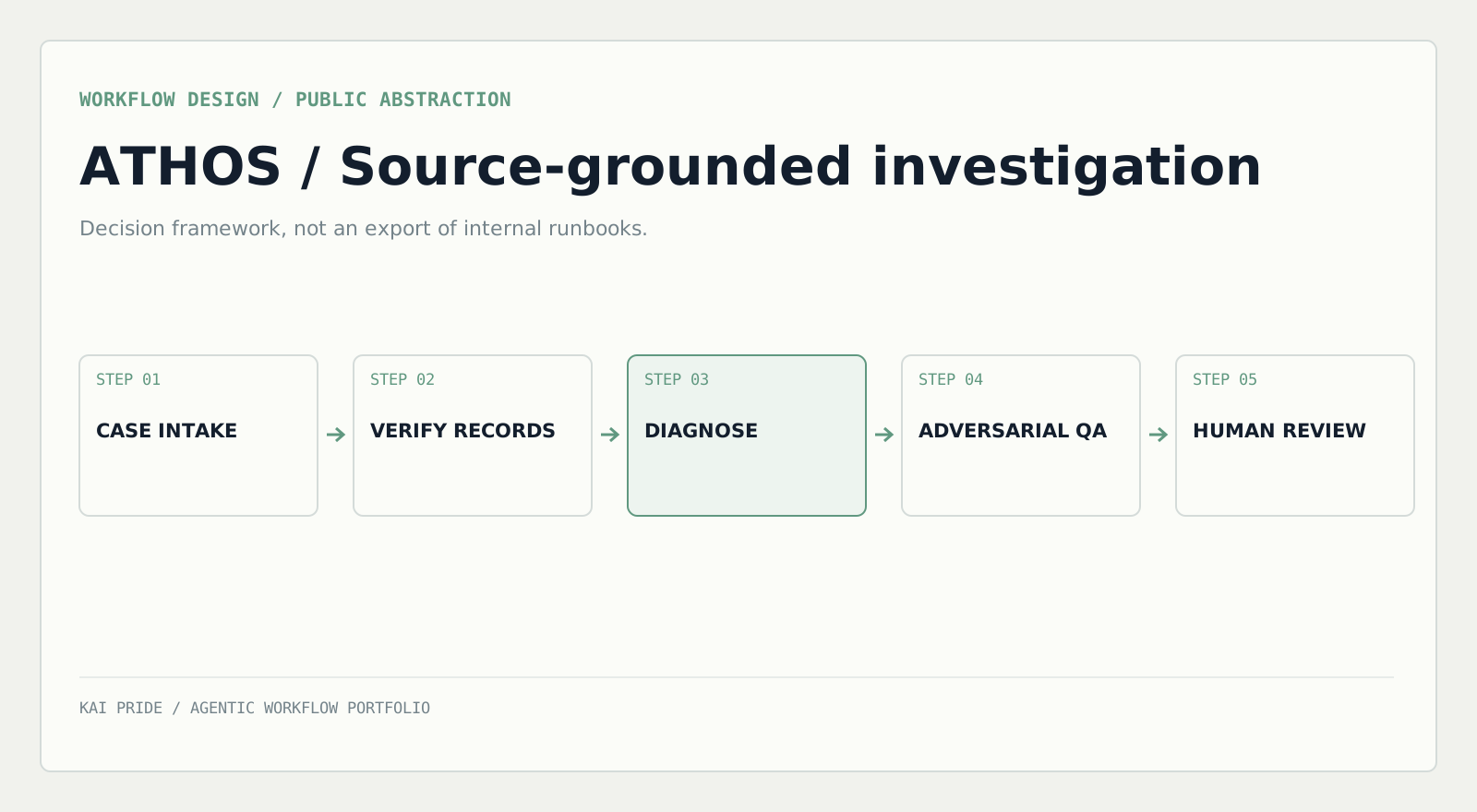
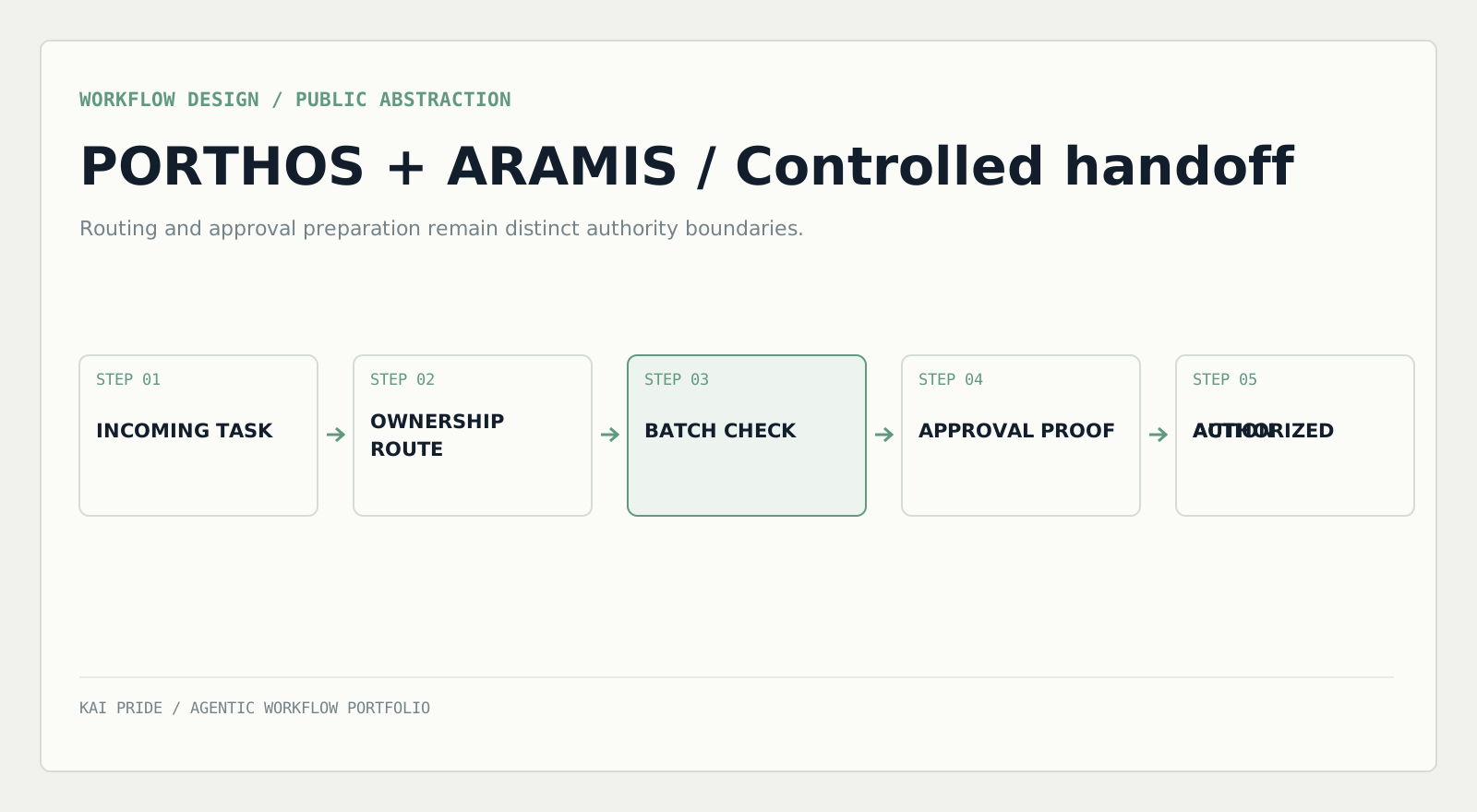
I built ATHOS to investigate billing issues, PORTHOS to route them and ARAMIS to verify the financial details and prepare an approval request. Keeping those jobs separate makes it clear who owns the next decision. I give calculations to a tool whose result a reviewer can reproduce, and financial approval to the person authorised to give it.
What happens when evidence runs out?
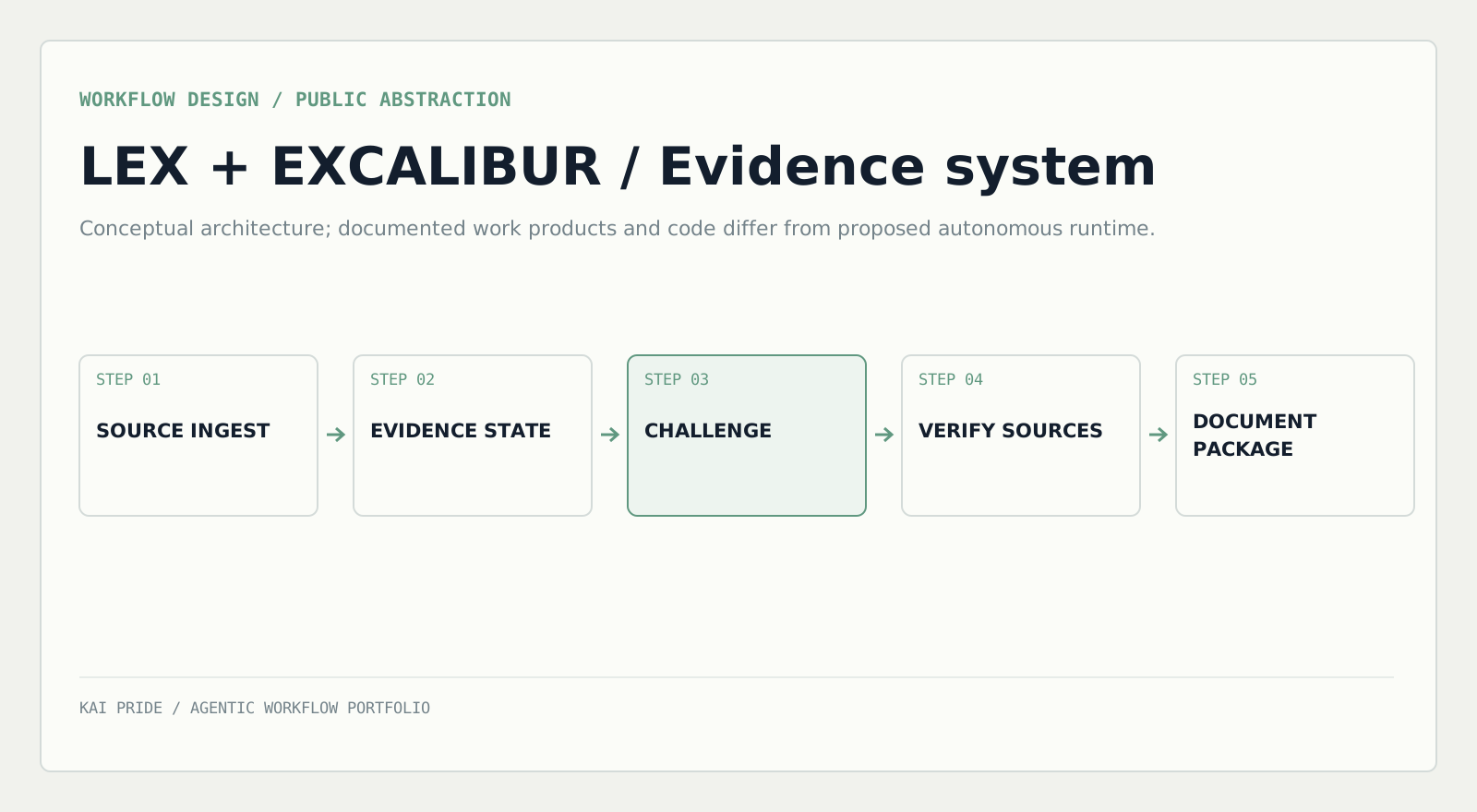
In LEX, I kept a chronology, a contradiction log and a list of missing records outside the conversation. That let me return to the precise finding a new document might change. I carry the same habit into finance. I record what we know, which decision is blocked and who can resolve it, so the next reviewer can pick up the work.
What do I reuse under pressure?
For an urgent billing run, I adapted an existing investigation workflow to help process 78 invoices worth approximately US$1.4 million. The adaptation included duplicate checks and a review point for exceptions. When time is short, I look for the smallest change that solves the immediate problem and keeps those checks in place.
Could a colleague run it without me?
While testing a monthly billing workflow, I found that a stale exchange rate could flow through to the final total. I tied the rate to the current payment statement and added an independent check after the workbook recalculated. When I walked a colleague through monitoring the workflow, the case log showed what had finished, what had failed and where to resume. That handover is part of what I consider a finished build.
ENGINEERING METHODOLOGY / 01
Methodology
From SOPs to Agentic Operating Procedures.
A Standard Operating Procedure describes how people do the work. An Agentic Operating Procedure translates that operational knowledge into an executable system: specialist reasoning, deterministic tools, explicit state, independent checks and human oversight. The goal is reliable automation—not autonomy at any cost.
My build methodology
Discover SOPs, failures, sources and decision rights → Model states, responsibilities and prohibited actions → Implement structured contracts and guardrails → Verify with negative tests, UAT and independent reconciliation → Operate with traceability, escalation and recovery.
Architecture proposals, concurrency guarantees and future hardening specifications are distinguished from verified production behavior.
THE SIX-STAGE METHOD
STAGE 01 / DISCOVERY
Map the actual work.
Identify systems, people, records, decision points and exceptions. Establish where the authoritative evidence lives before choosing an automation design.
Process discovery · Source-of-truth mapping
Engineering practice
Controlled language
I write procedures that finance teams can review and engineers can implement. My approach aligns with ASD-STE100 Simplified Technical English through consistent terminology and direct instructions. I choose verbs carefully because they define authority. Requesting an adjustment, approving it and applying it are three distinct actions. For each, I name who may act and what evidence confirms the action took place.
I carry those distinctions into agent handoffs and JSON schemas. Each handoff states what triggers the next step, which records it requires and what the receiving agent must return. When evidence is incomplete, the procedure identifies the decision that remains open and who owns it. The next reviewer can see where to resume.
Deterministic arithmetic
I use JSON schemas to define the financial data a calculation requires. The currency, original amount, proposed correction and difference each have a distinct field. The record links those figures to supporting evidence and preserves the distinction between an unknown amount and zero.
I separate the agent that coordinates the work from the calculator that performs the arithmetic. A versioned Python workflow checks the inputs before updating the workbook. After recalculation, an independent check reads back the stored values and reconciles exchange rates and totals against the invoice records and monthly statement. The reviewer can trace each result to its source, see which figures agree and identify any discrepancy that needs investigation before approval.
Scenario testing and phased agent rollout
I design each test around three questions. What should the agent do? What must it be prevented from doing? Which record would prove the outcome? I tie each test to a specific workflow revision and compare the expected result with what actually changed. For an interrupted run, I check which steps completed before allowing a retry. For a case that should stop, I verify that the agent recorded the reason and took no further action.
I design pilots to start in shadow mode. The agent prepares recommendations for a defined queue, and an authorised reviewer decides what moves forward. I track cases the agent marked ready too soon as well as cases it held unnecessarily. I also distinguish a planned approval from a correction the reviewer had to make. That distinction shows where oversight is working as designed and where the workflow needs revision.
When I expand a pilot, I test changes to workload separately from changes to permissions. A higher caseload tests whether the workflow remains reliable under pressure. A new permission requires evidence that the platform allows the intended action and blocks prohibited ones. Before expansion, I define when to pause intake, how to account for work already in progress and who takes ownership of open cases if the team returns to the manual process.
APPLIED EXAMPLE / FINANCIAL OPERATIONS
Multi-agent financial reconciliation
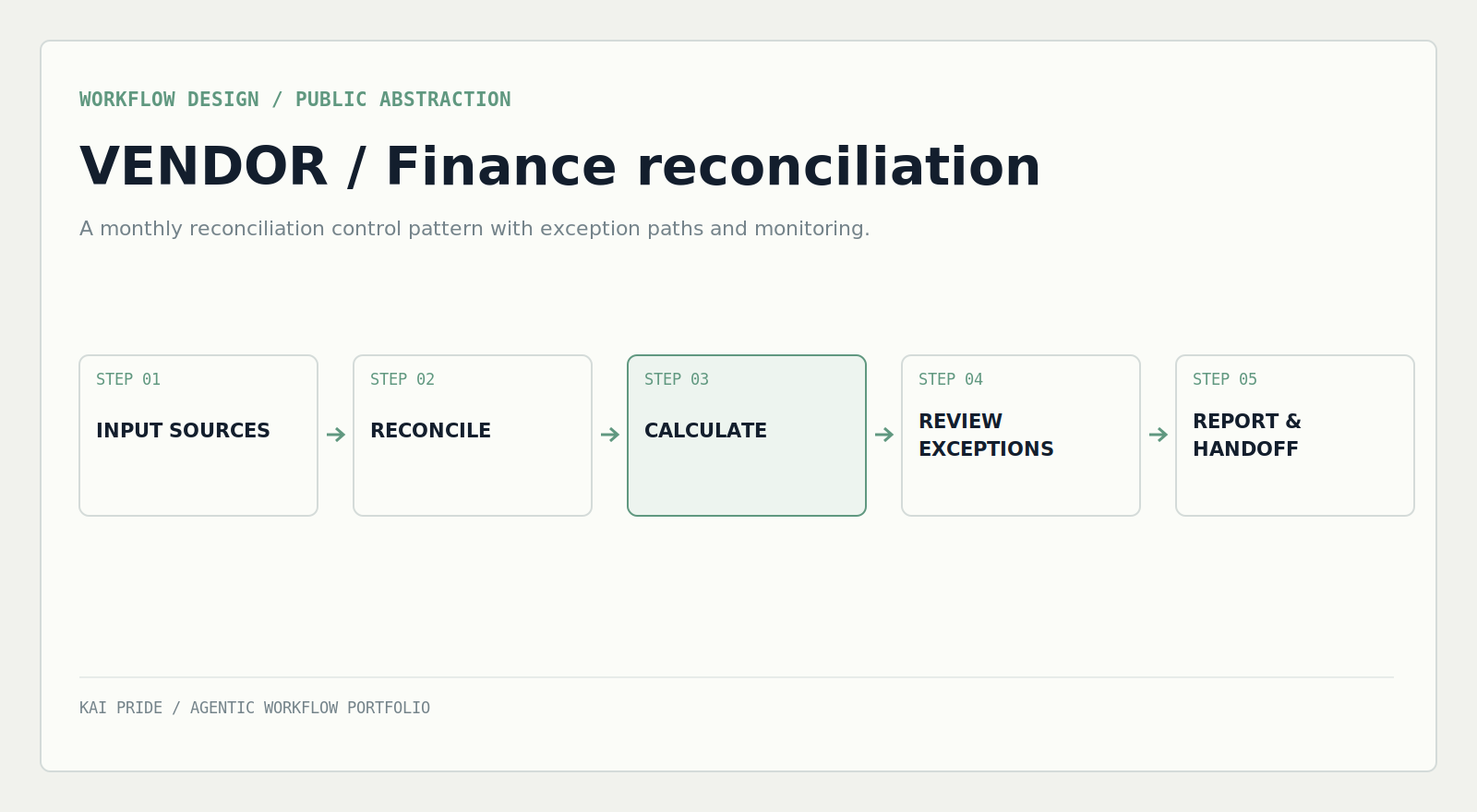
Consider a recurring reconciliation that requires collecting records from different systems, comparing charges, investigating mismatches and coordinating exceptions. Rather than asking one model to perform every task, the procedure is decomposed into a controlled sequence of retrieval, calculation, investigation, verification and human review.
MANUAL SOP
Gather evidenceLocate records across systems
Compare and calculateReconcile values and periods
InvestigateResolve exceptions across owners
ReviewDocument findings and secure approval
→
AGENTIC AOP
OrchestratorCoordinates state, dependencies and execution
Controlled outcomeReconciled output or human escalation
Specialist subagentsDelegation, scoped tools, explicit interfaces and controlled handoffs
Transaction integrityIdempotency, duplicate checks and execution-state verification
AI assuranceAdversarial review, regression testing and evidence provenance
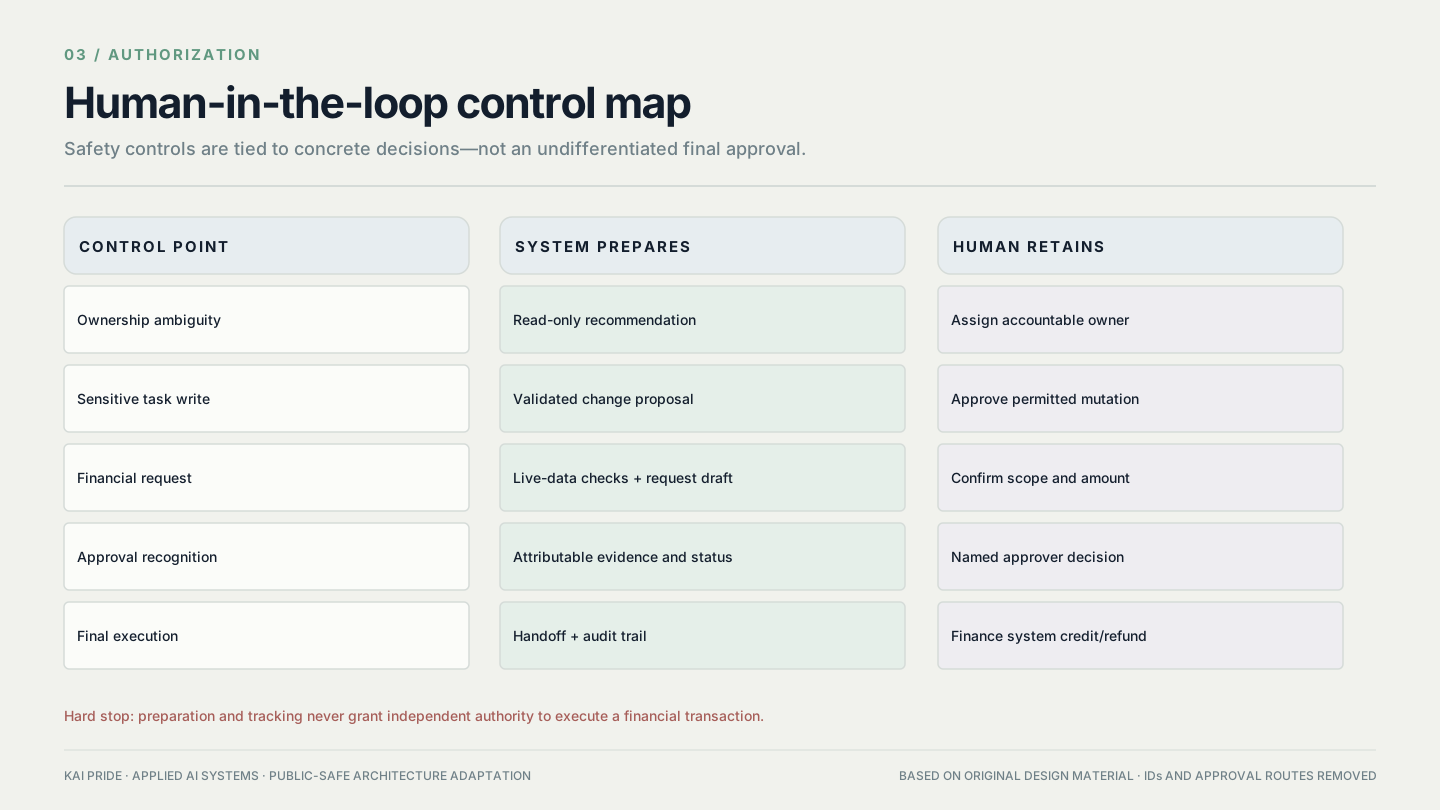
Human governanceApproval thresholds, exception queues and auditable decisions
Independent review architecture
Four complementary review functions.
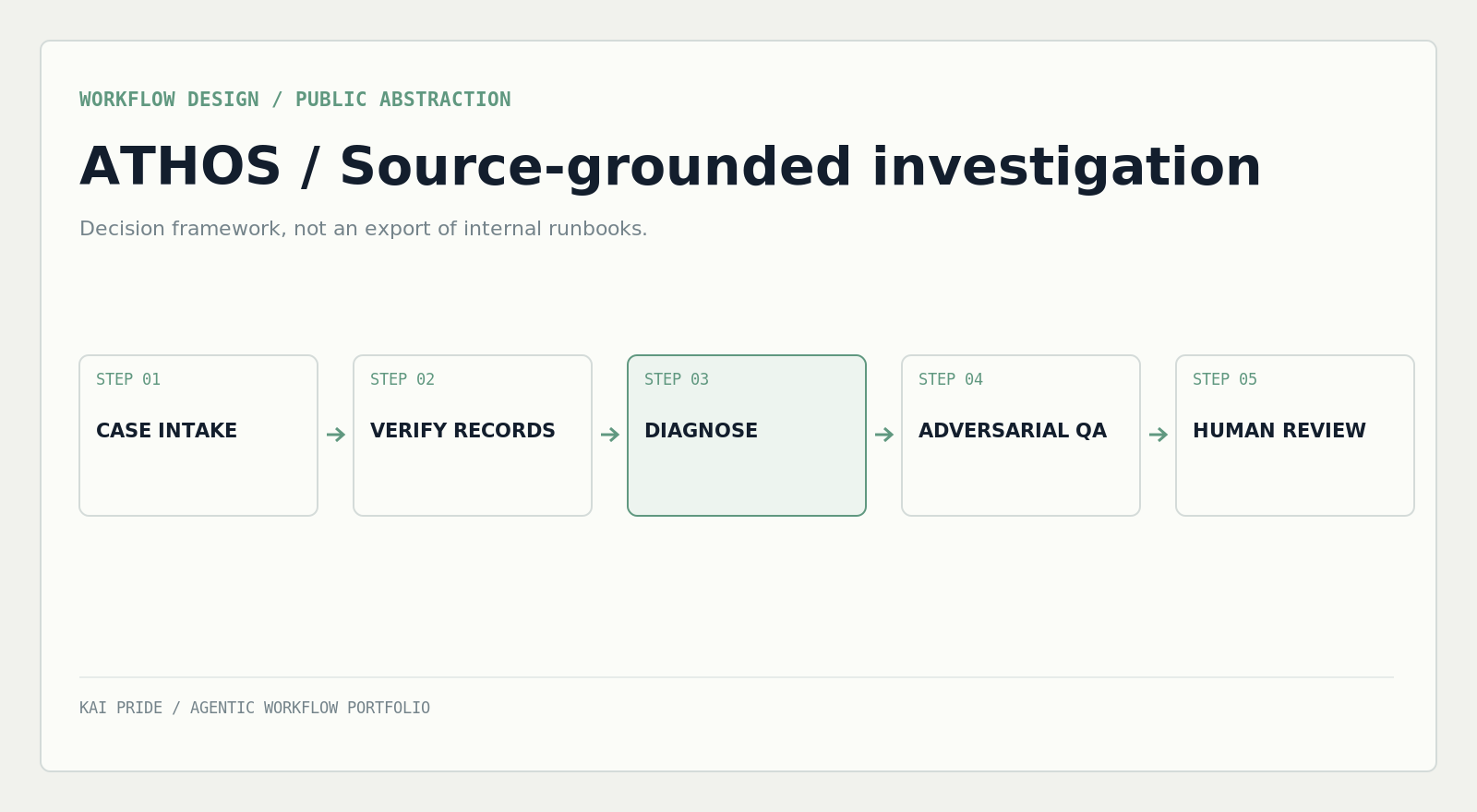
An invoice can be wrong even when its cause is still unknown. In my ATHOS investigation design, four review functions keep that distinction visible. Each answers a different question and leaves a record that the next reviewer can challenge.
01 / EVIDENCE
Blue
What do the records establish?
Blue links the claim to the correct entity, invoice and billing period. It checks each fact against the source that governs it. Signed terms establish the agreed price, an issued invoice shows the charge, and a settlement record shows what was paid. Blue records the source reference and separates observed facts from a provisional explanation.
HandoffA source-linked diagnosis with the missing evidence identified.
02 / CHALLENGE
Red
What evidence would change the diagnosis?
Red tests the strongest competing explanation against the original records. It looks for a link to the wrong transaction, a rule applied outside its effective dates or an exception omitted from the initial review. For each material objection, Red identifies the check that would distinguish the two explanations.
HandoffAn objection, the decision it could change and the evidence needed to settle it.
03 / RECONCILIATION
Purple
Which findings survive the challenge?
The case controller reconstructs the sequence from agreement to charge to settlement. It compares conflicting records by authority and effective date, then records how each Red objection changed the finding or why the evidence resolves it. An open question about the cause can block a proposed remedy while leaving a verified discrepancy intact.
HandoffA revised finding, the reason for each decision and an owner for each unresolved issue.
04 / VERIFICATION
Gold
Can an independent reviewer reproduce the recommendation?
Gold checks the exact draft revision against the decisive source records. It verifies case identity, recalculates material amounts and checks the applicable policy and approval evidence. A changed source or a revised conclusion reopens the checks that depend on it. A human retains authority over any financial action.
HandoffPass for human review, return for rework or escalate with the failed check identified.
How this draws on my work
In a bank-file billing review, our team found that the workflow used payment method to infer pricing eligibility. I proposed comparing historical charges, false positives and exclusions to identify where that assumption failed. In LEX, I maintained source-linked chronologies and contradiction logs so a reviewer could revisit an objection after new evidence arrived. The ATHOS specification sets out how to carry those disciplines into a repeatable review of a financial case.
Applied AI and automation solutions for complex business challenges—from revenue operations and reconciliation to multi-agent investigation, approval orchestration and evidence-based decision support.
01 / AUTOMATION
Automation-driven projects
Translate fragmented, manual financial processes into structured workflows with calculation controls, exception handling and measurable operational impact.
Selected builds
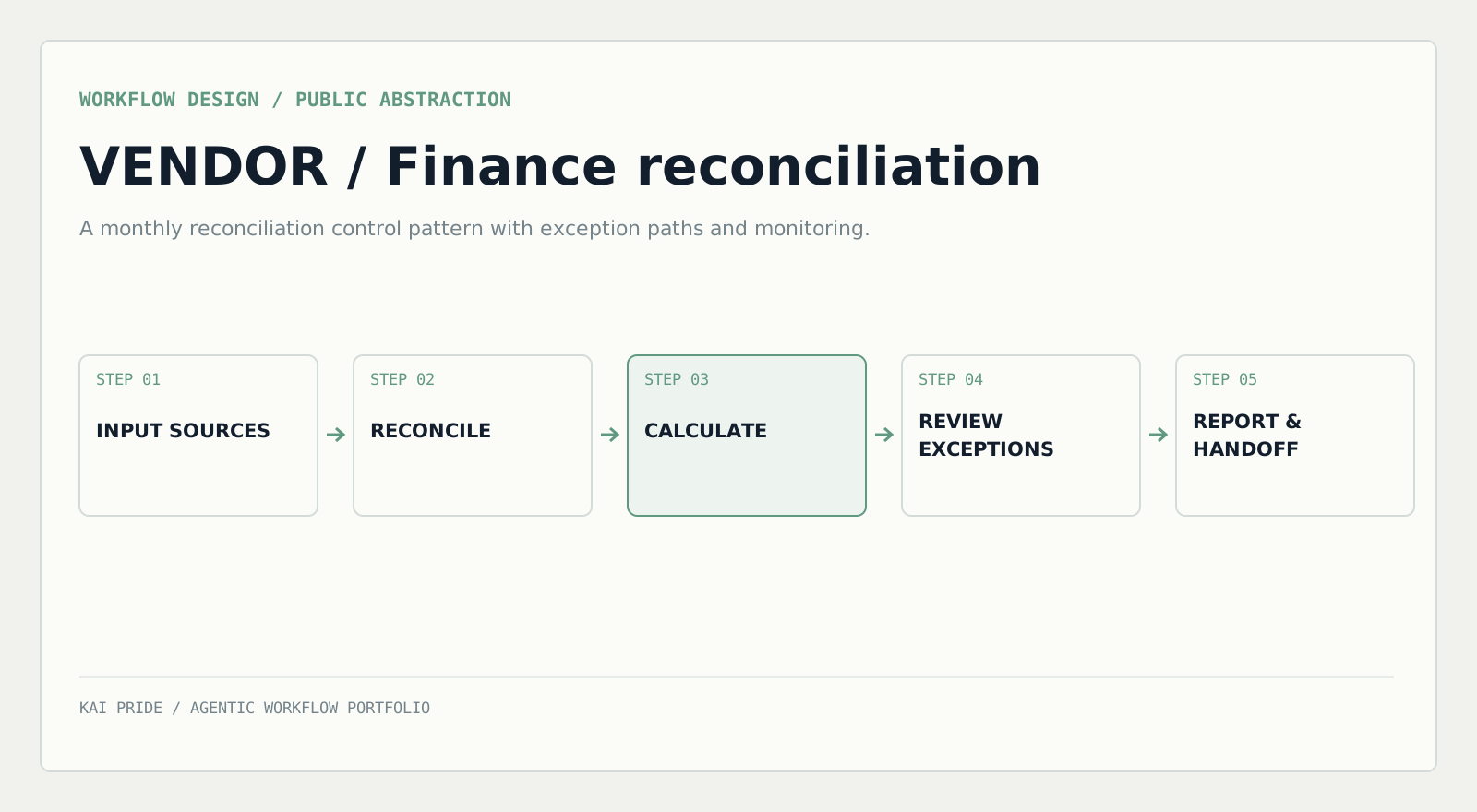
VENDOR: recurring billing reconciliation, calculator logic and exception routing. Emergency billing: 78 invoices representing approximately US$1.4m in invoice value processed through an adapted workflow, with duplicate prevention.
Building intelligent workflows for real operations.
Designing and building AI automation systems starts with architecture: translating business requirements into connected components, clear interfaces, data flows and decision boundaries. Agents, business systems and human approvals are designed to work together, with integration, exception handling and traceability built in from the outset. That structure guides implementation, validation and operational handover.
Workflow architectureTranslating SOPs into agentic procedures with defined states, responsibilities, tool permissions and handoffs.
Data and controlsStructured JSON contracts, deterministic calculations, source-linked evidence and human approval gates.
Validation and handoverNormal, exception and failure scenarios, controlled pilots, escalation paths and documented operating guidance.
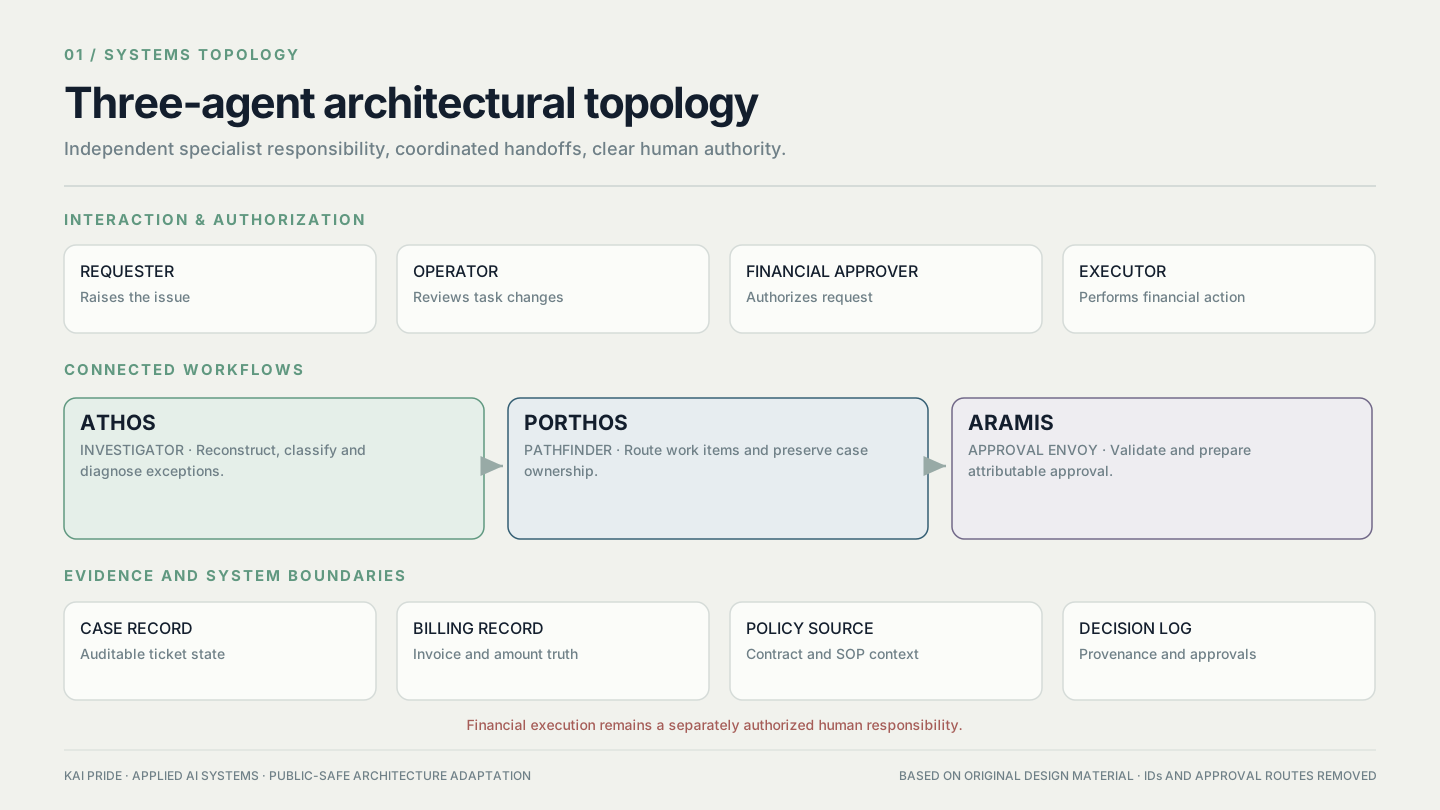
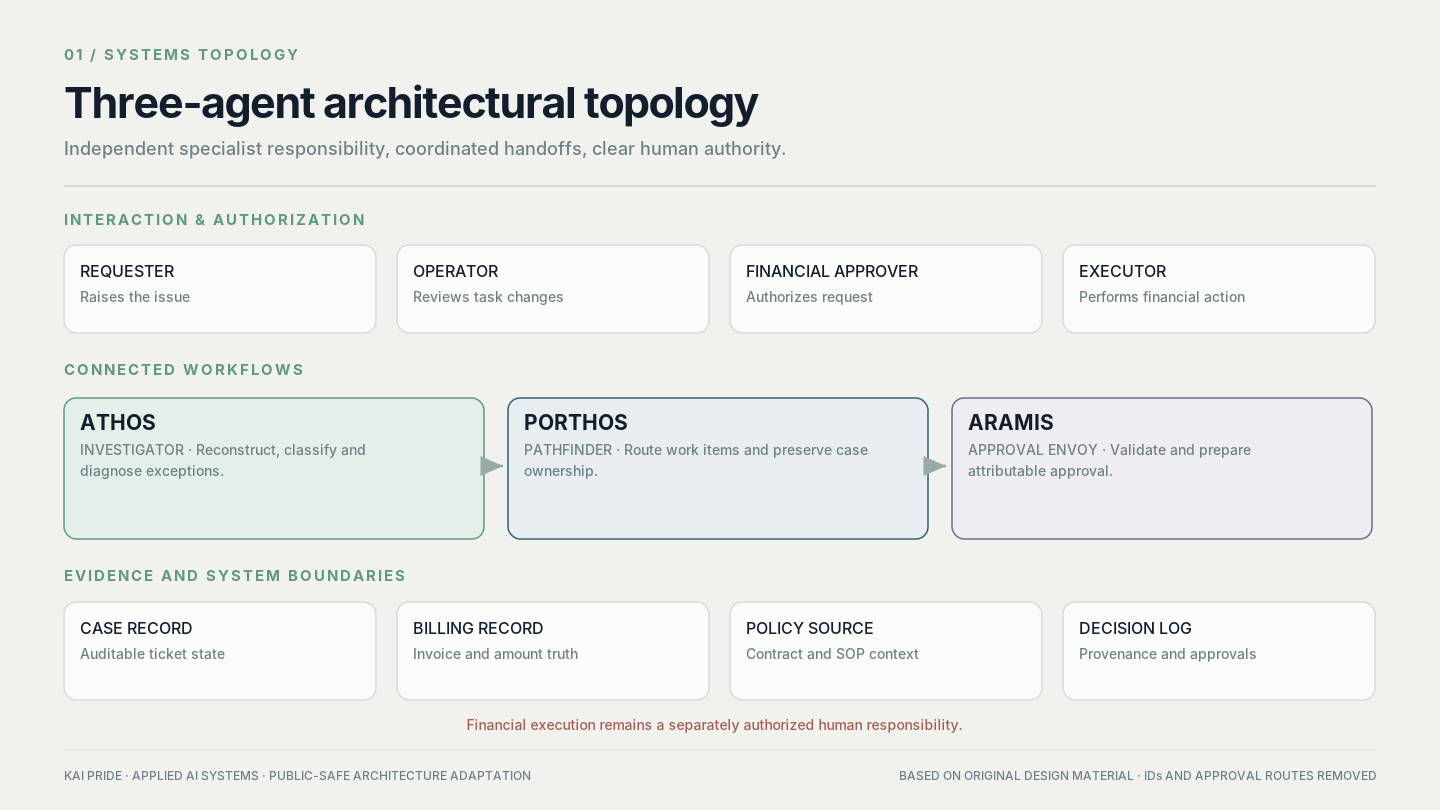
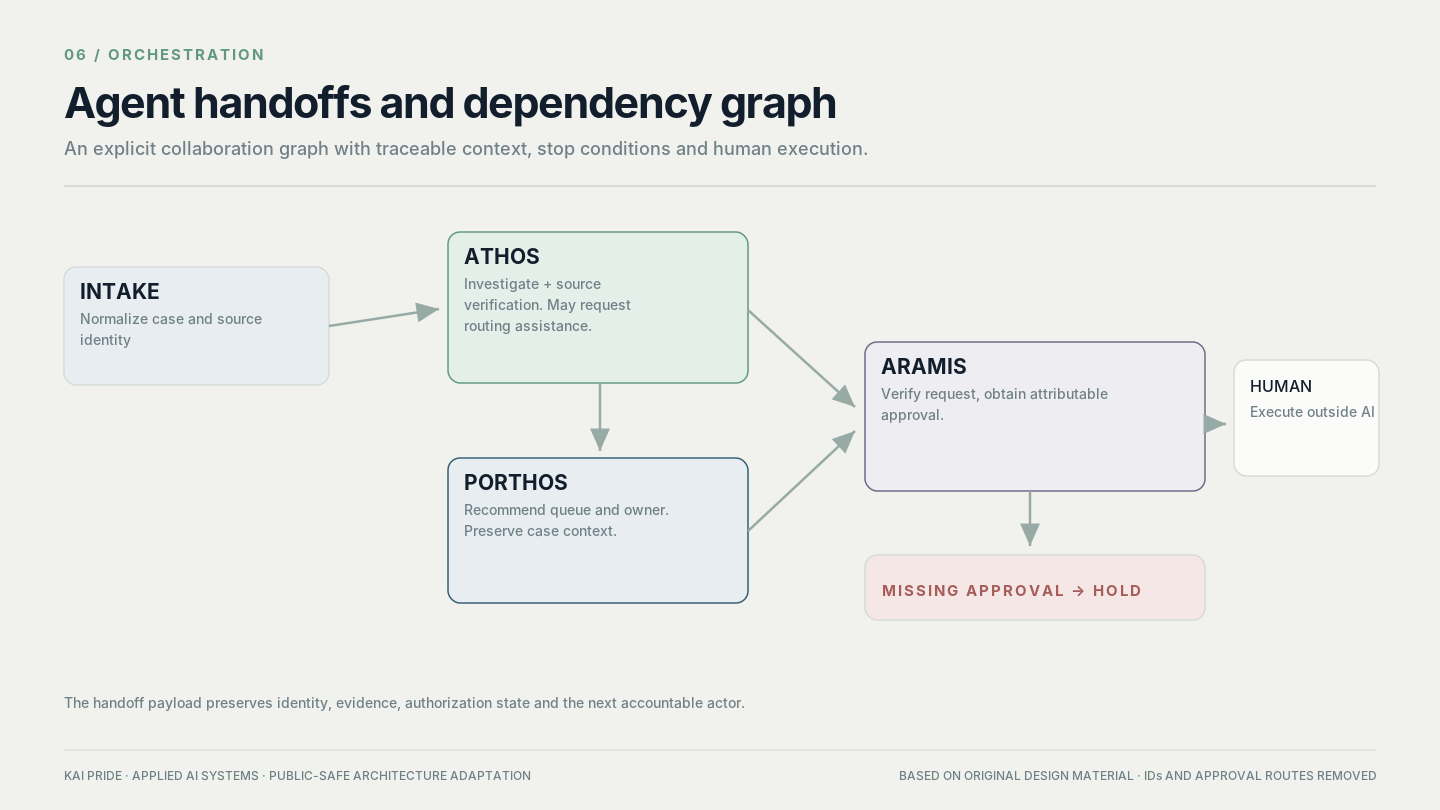
Three interconnected specialist responsibilities: ATHOS investigates and stages defensible findings; PORTHOS routes work to accountable owners; ARAMIS prepares controlled approval requests. Operational implementations and later proposed controls are distinguished in the case studies.
2,434hCOMBINED AGENT SESSION ACTIVITY
01 / THE INVESTIGATOR
ATHOS
1,500h
AR Triage L1: 1,423h · separate ATHOS workflow: 77h
Complex finance investigation, source-of-truth verification, SOP grounding, scoped diagnosis and human review. Includes design refinement, case execution and an independently specified controller extension.
1423h L177h additional ATHOS
02 / THE PATHFINDER
PORTHOS
707h
September 136h · October 571h
Work-item classification, task routing, queue ownership and orchestration across finance teams. Later batch-grouping and bulk-correction changes remain documented proposals.
343 sessions in Sept132 sessions in Oct
03 / THE APPROVAL ENVOY
ARAMIS
227h
September 106h · October 121h
Approval preparation, supporting references and controlled financial handoff. Documented remediation specifications add approval evidence and owner continuity but must not be represented as deployed.
675 sessions in Sept2,665 sessions in Oct
FOURTH WORKSTREAM / VENDOR
Finance reconciliation automation
Separate monthly billing engine, calculator, reconciliation exceptions and operational ownership transfer.
VENDORMonthly billing engine
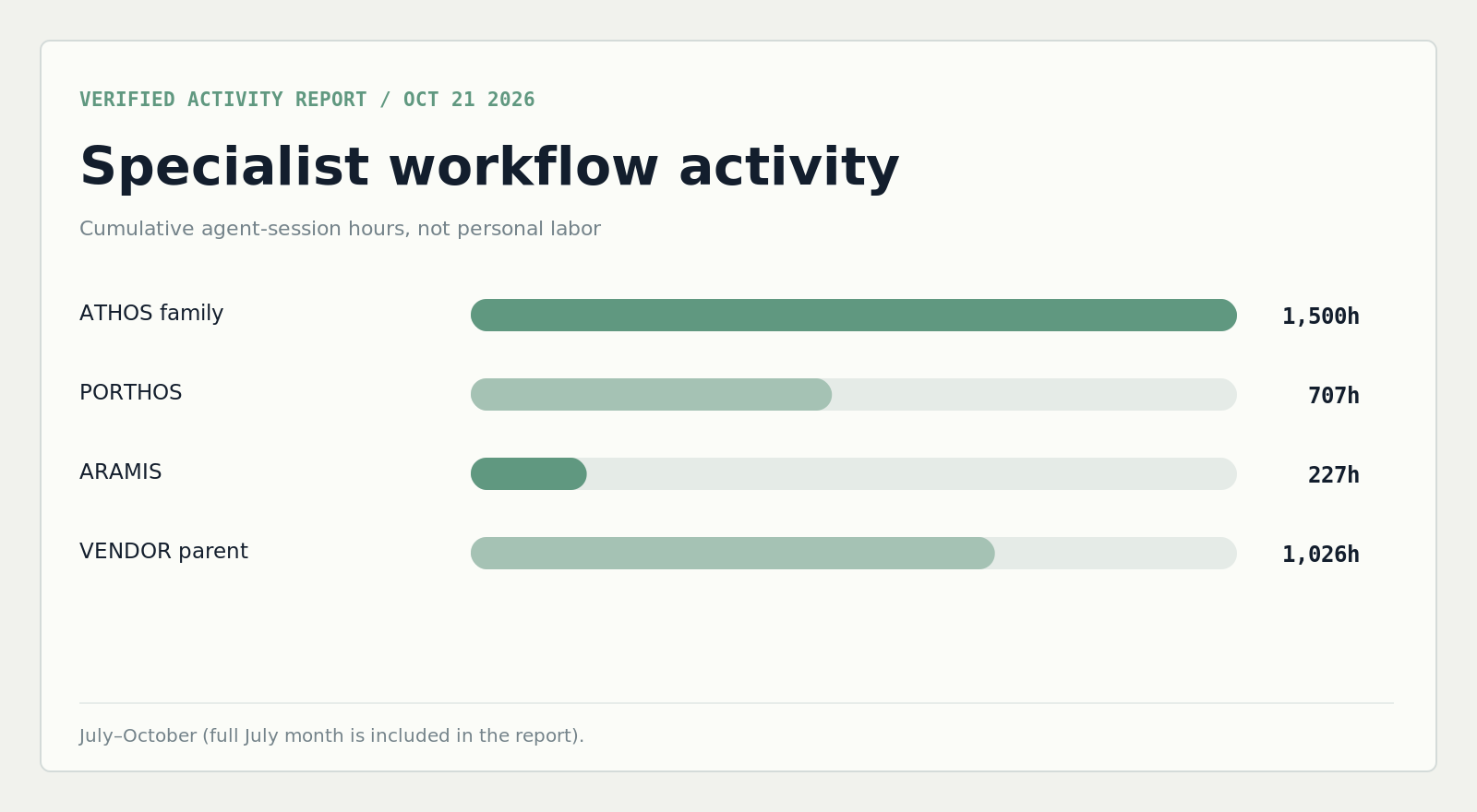
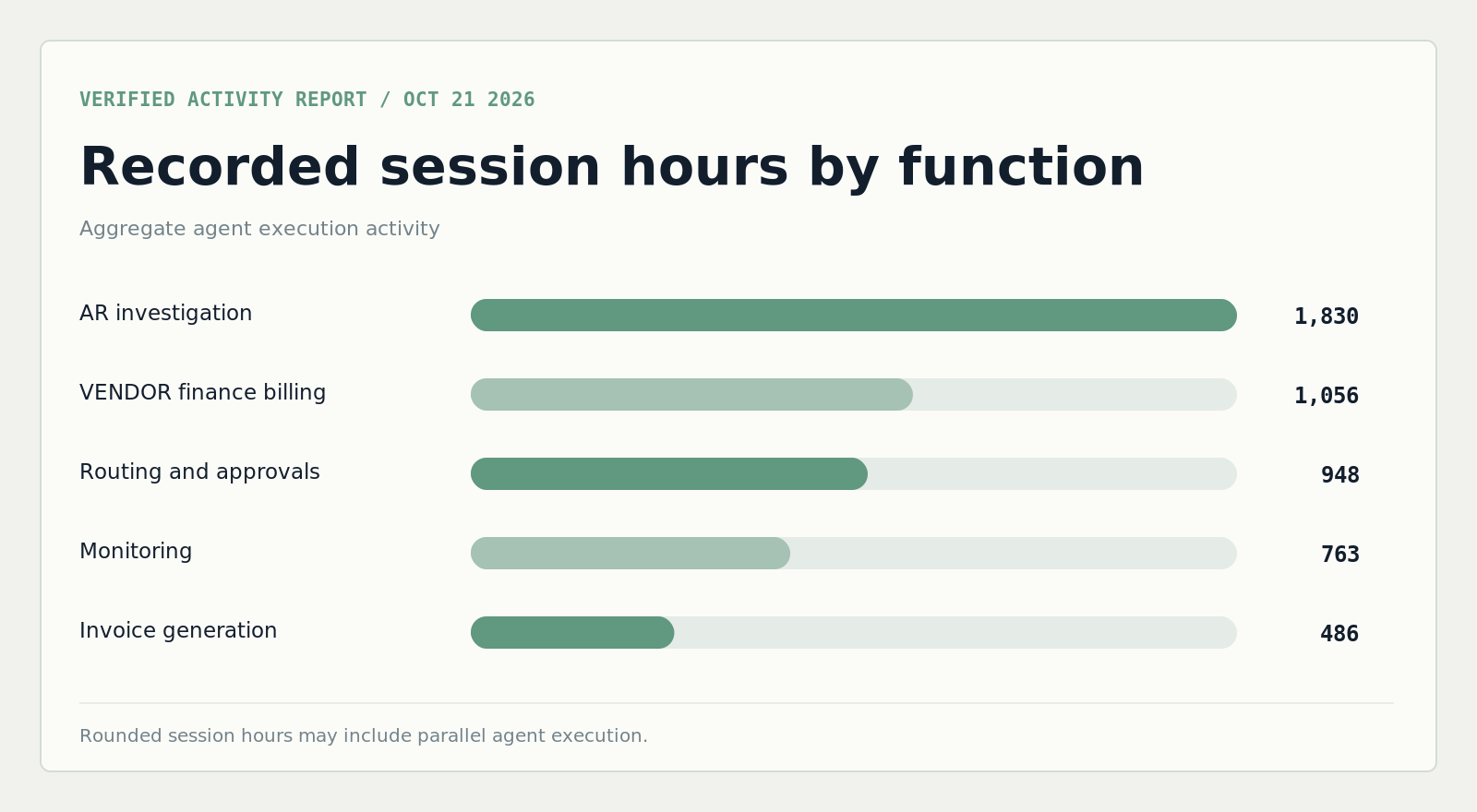
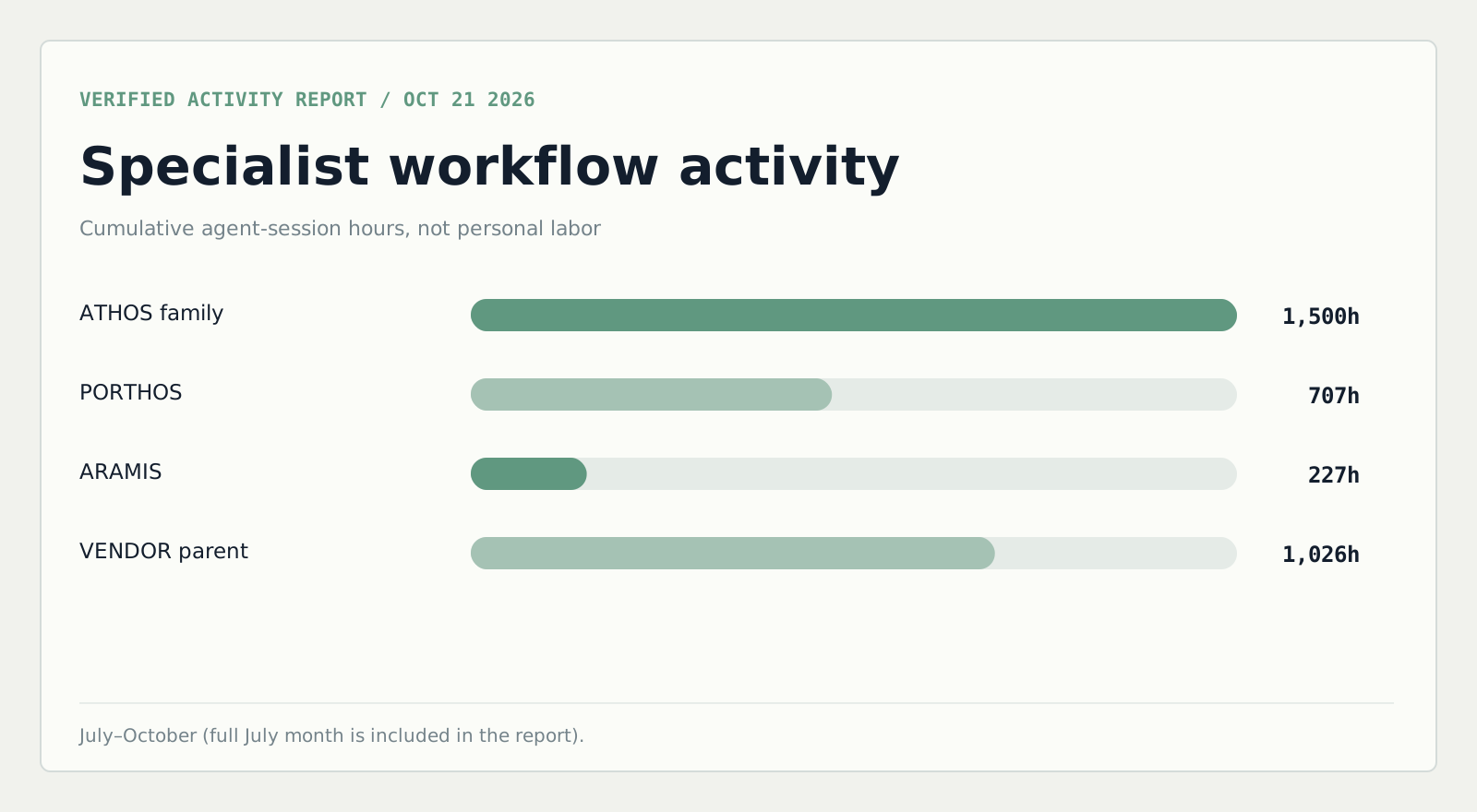
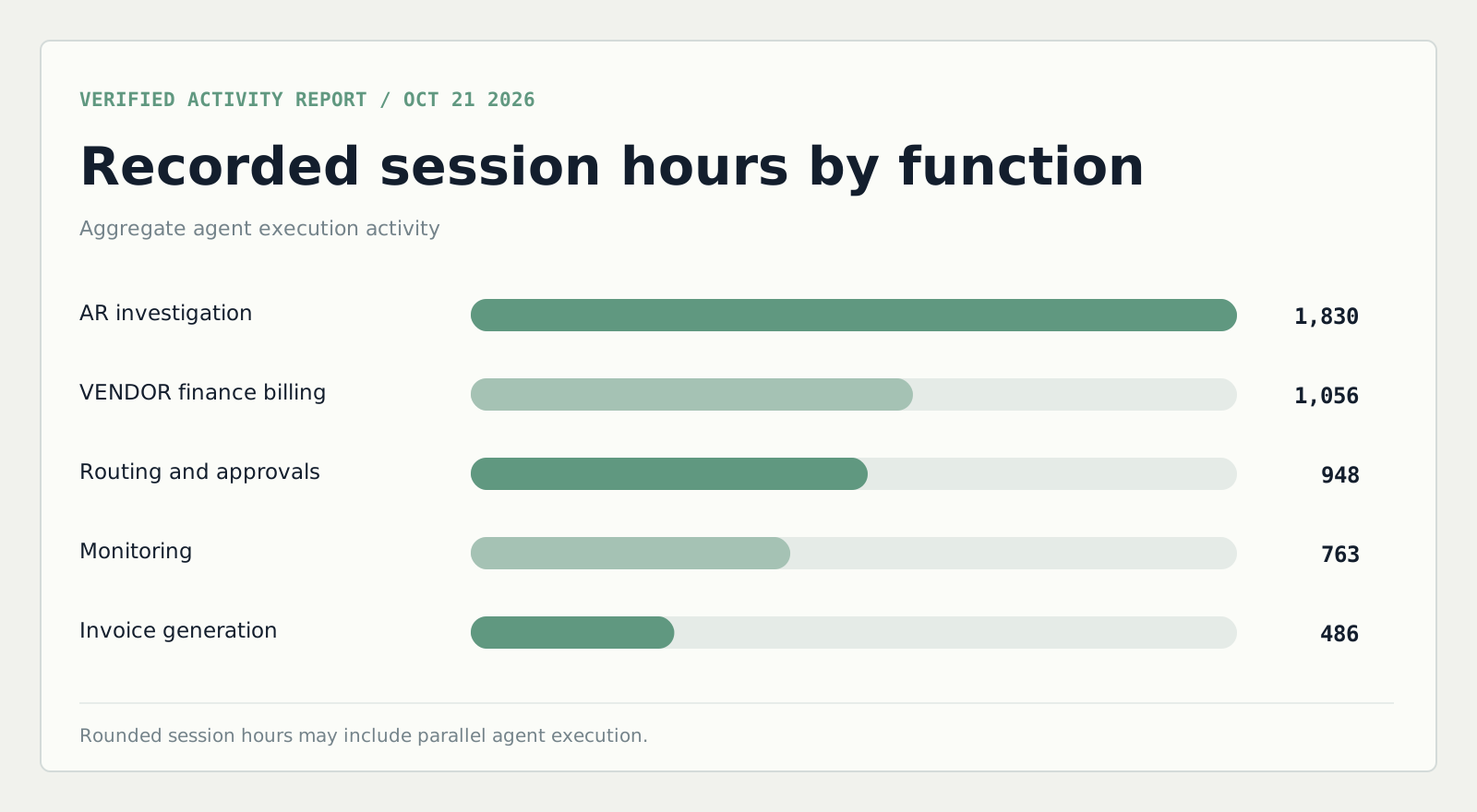
Definitions: ATHOS total combines AR Triage L1 (ID L1, July–Oct: 26 + 215 + 350 + 832) with separately reported ATHOS (ID ATHOS, Oct: 77). PORTHOS and ARAMIS use September–October reported session durations. VENDOR uses the parent-engine August (109), September (829), and October (88) values; the calculator is not added a second time. All are rounded agent-session hours, not a personal time sheet or measured human productivity savings.
NEW / SOURCE-DERIVED VISUAL SYSTEMS
Agentic architecture. Workflow demonstrations.
Explore system diagrams and a narrated walkthrough of investigation, routing and approval architecture.
06 PLATES / ACTUAL PROJECT REFERENCES
ORIGINAL WORK / PROJECT WALKTHROUGH
The Three Musketeers of AKAI. In my original narration.
My complete recorded explanation of the connected-agent design: ATHOS investigates, PORTHOS determines the responsible route and ARAMIS prepares the approval workflow. Presented as a source artifact, with its original soundtrack and slides.
Topology architecture walkthrough · original audio · 2:36.7.
THREE CONNECTED SPECIALISTS
ATHOS. PORTHOS. ARAMIS.
Investigation, routing and approval operate as separate responsibilities. The architecture relies on explicit case handoffs and source validation, while financial execution remains outside the agent boundary.
1,500hATHOS family707hPORTHOS227hARAMIS
Reported cumulative agent-session durations, not personal engineering hours or verified time saved.
DESIGN PLATE / 01
Connected-agent topology
Connected investigative, routing and approval responsibilities across an explicit human authority boundary.
I expanded receivables automation beyond a single triage agent into a layered AI workflow system spanning L1 intake, L2 investigation, L3 escalation, Slack orchestration, duplicate checking and specialist approval routing.
OCTOBER 2026 / AR TRIAGE L2
153 cases · 219 sessions
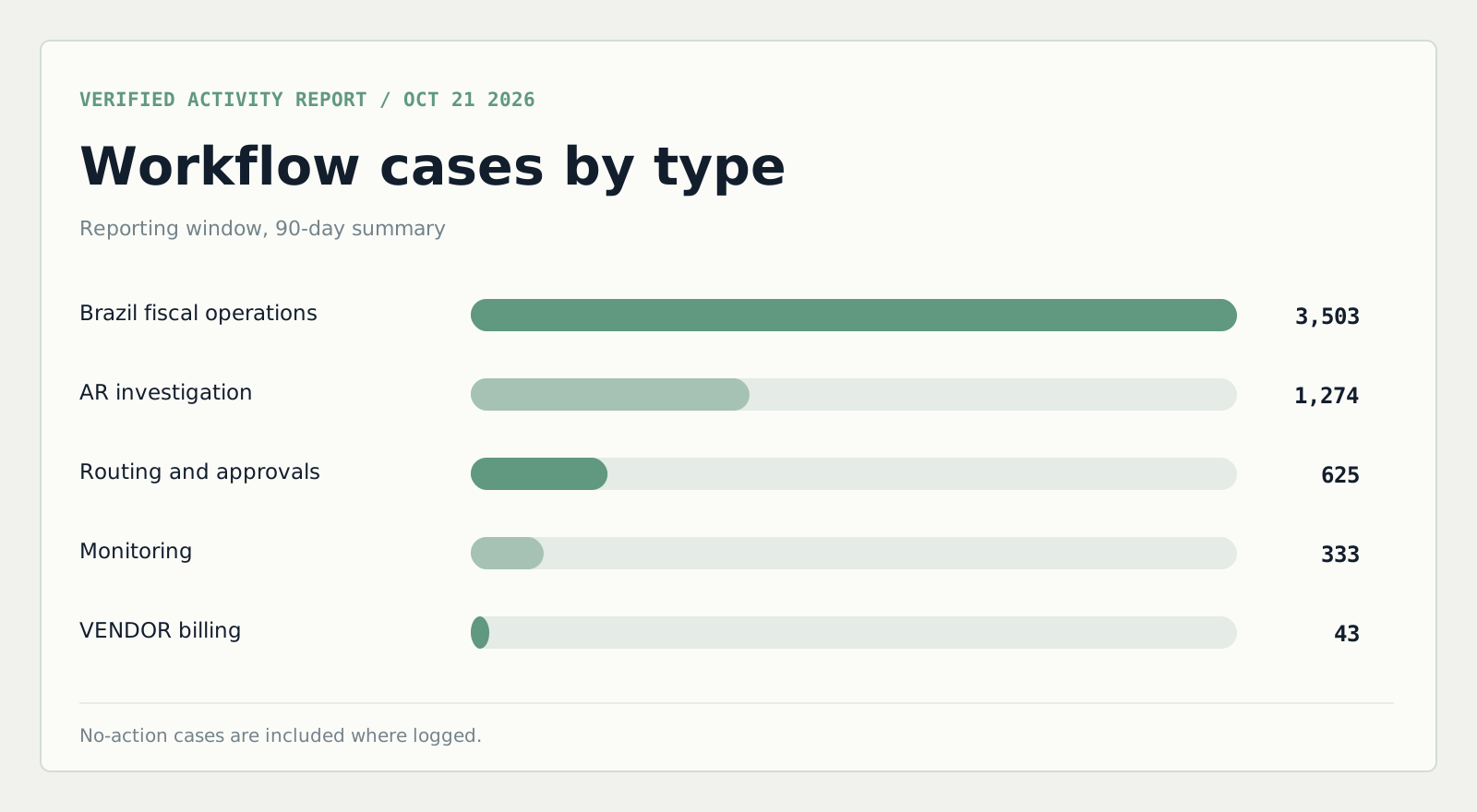
Approximately 154 agent-session hours across the L2 workflow. The reported case mix includes 121 partly automated, 1 fully automated and 31 no-action cases. The figures describe execution activity, not human engineering hours.
L1: 386 October cases. L2: 153. L3: 18. Complementary workflows include Slack intake and automation, duplicate checks, ATHOS investigation and AR auto-close. These are separate workflow counts and should not be summed as unique customers or incidents.
Investigation handoffs
The L1 intake, L2 investigation and L3 escalation stages carry the case identity forward so the next owner can pick up the investigation.
FIELD STUDY 07 / REVENUE INTEGRITYCROSS-FUNCTIONAL TECHNICAL REVIEW
AI ASSURANCE / DESIGNING FOR REAL FINANCE OPERATIONS
Automate the correct rule. Not the wrong assumption.
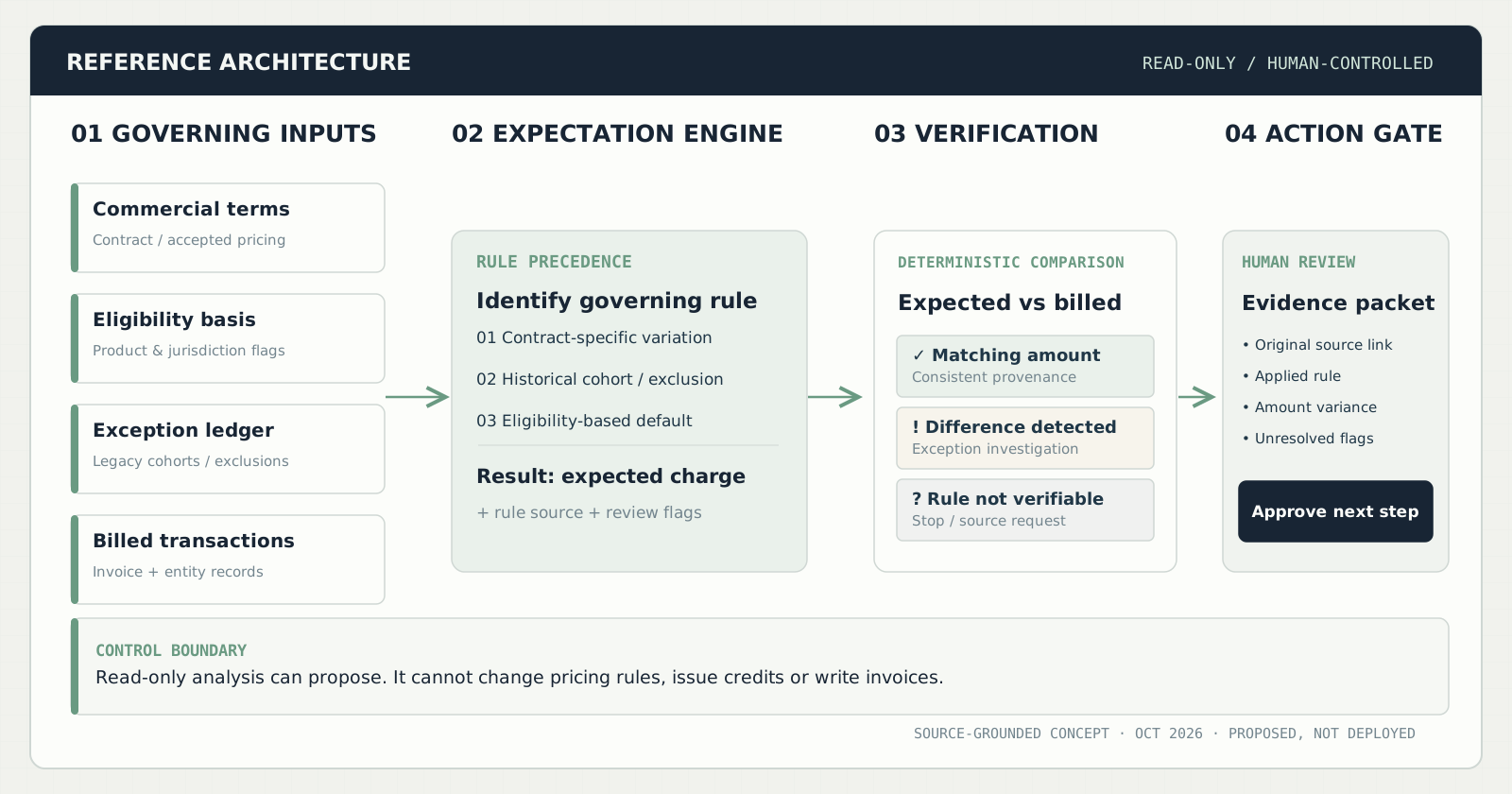
My contribution combined revenue assurance, AI architecture and commercial-rule analysis: identifying the authoritative pricing rule, reconciling cohort exceptions and designing an independent read-only investigation path to flag discrepancies before they scale.
Reference design derived from the documented review. The investigator and remediation controls are proposed, not a verified deployed implementation.
01 / OBSERVED PROBLEM
A proxy was used where a governing rule was needed.
The review discussed erroneous price selection when an operational payment attribute was used as a substitute for the actual eligibility basis. Cohorts and overrides were distributed across tools.
02 / MY TECHNICAL CONTRIBUTION
Red-team the rules before extending automation.
I proposed retrospective case testing, exception grouping, false-positive analysis and a consistent source of truth—so the investigator could explain discrepancies with evidence, not issue silent corrections.
03 / ENGINEERING CONTROL
Diagnose without acquiring execution authority.
The proposed bot remains read-only. Missing source data triggers review; potential corrections go to accountable owners and require separate approval before any production write.
Bank-file billing assurance. Find the rule before scaling the automation.
In a cross-functional technical review, I applied financial systems expertise and AI assurance thinking to an automation that was producing inconsistent bank-file fees. We traced the problem to the difference between a convenient data field and the actual governing commercial rule.
PRICING LOGIC / ROOT CAUSE
Wrong proxy. Wrong price.
The reviewed automation used payment-method classification for new-entity pricing where treasury eligibility should govern. Historical pricing cohorts and exclusions required separate validation, alongside the applicable eligibility rule.
I proposed systematic retrospective validation, data-warehouse investigation of missing automation coverage, and AI-assisted expected-versus-billed comparisons. The team discussed a read-only Bank File Investigator connecting Slack and Snowflake; the meeting assigns further validation and approval steps rather than proving deployment of my proposed changes.
A dated, 30-page technical case study reconciles the three live specialist workflow revisions and documents the actual limits of delegation, verification and financial authority. This public summary omits internal configuration IDs, named approvers, customer records and proprietary rules.
DOCUMENTED SNAPSHOT / 22 SEP 2026
01 / TECHNICAL CONTROL
Input trust & intake variants
Direct task references, batch queues and communication threads are different authorized entry modes. Data inside a ticket cannot silently become workflow instructions.
Recorded live-state workflow specification02 / TECHNICAL CONTROL
Invoice-status routing
Outstanding invoices follow a correction path; paid invoices requiring refund follow a separate finance execution path; processing or unknown states are held for manual triage.
Confirmed in September workflow revision03 / TECHNICAL CONTROL
Cross-caller identity & deduplication
Case keys retain the investigation chain while work-item identity detects two callers opening approval work for the same item. An open-case check is not an atomic concurrency lock.
Confirmed control; concurrency not proved04 / TECHNICAL CONTROL
Independent financial verification
The approval specialist re-checks document identity, type and amount against source records instead of inheriting an upstream diagnosis as fact. Unverifiable requests remain open for clarification.
Documented live-state design05 / TECHNICAL CONTROL
Approval record & authority
Exact request confirmation, named approver evidence, a native ticket approval record, and eventual human financial execution are distinct events. Communication reactions are not the controlling ledger.
Confirmed live-state September revision06 / TECHNICAL CONTROL
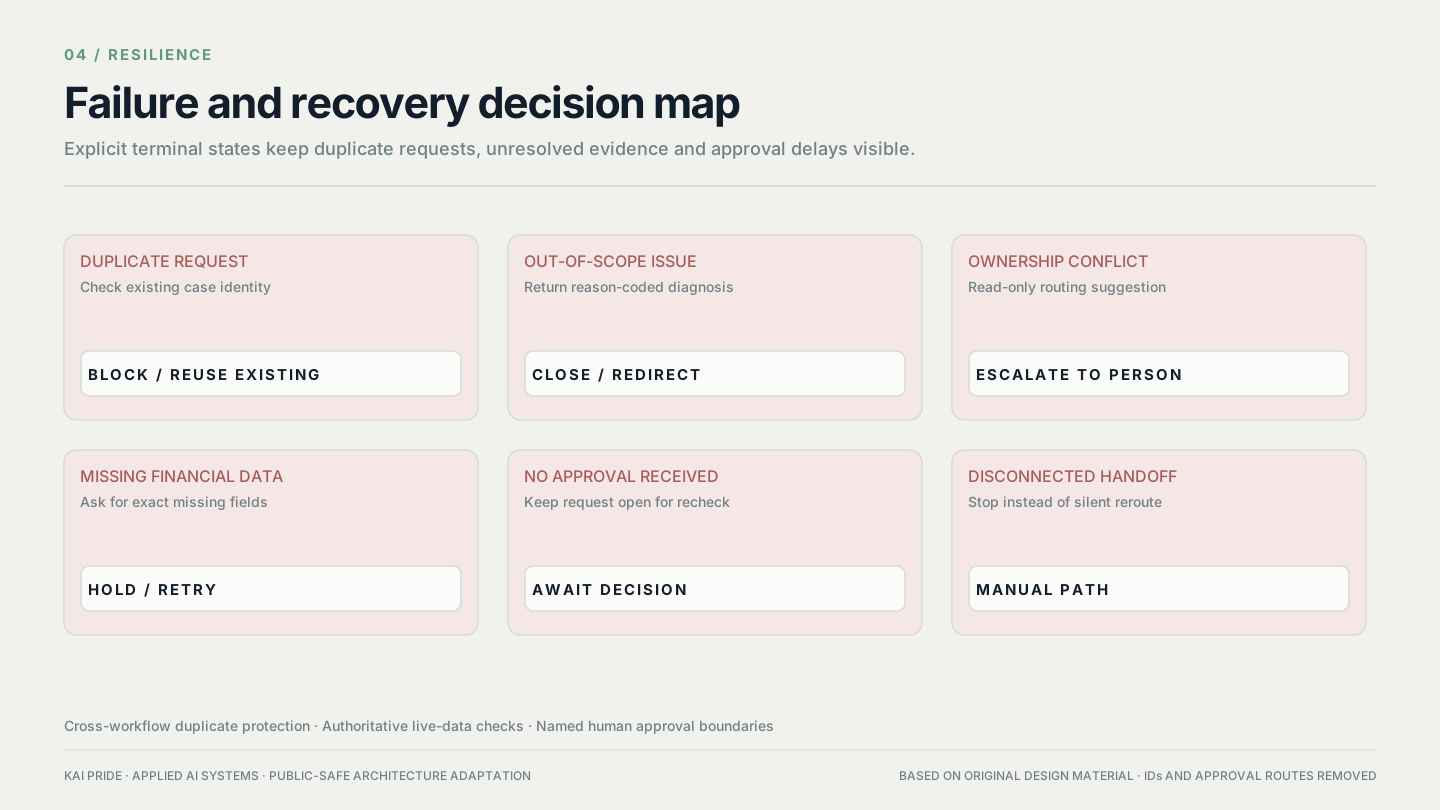
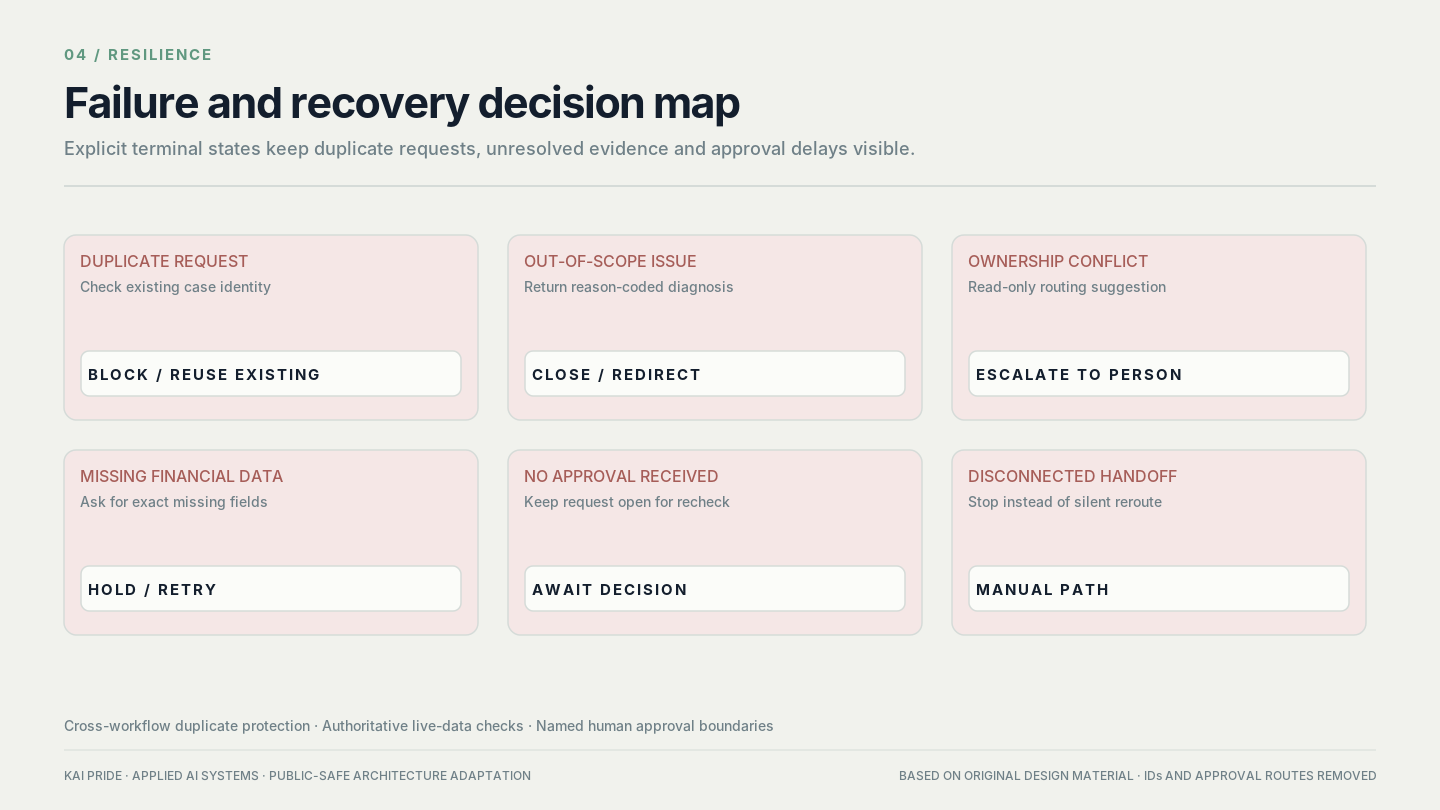
Observable failure states
Closed cases, duplicate work, missing connections, refused approvals and unresolved fields have explicit stop or hold outcomes rather than an invented success state.
Documented control; full test coverage unverified
VERIFIED / DOCUMENTED BY SEPTEMBER 22
Implemented control boundaries
Invoice-state ownership gate · direct and batch intake distinctions · cross-caller duplicate search · independent amount verification · approval-reference validation · ticket-native approval record · narrowly authorized task writes.
PROPOSED / NOT VERIFIED
Validation still to be completed
Atomic locking for simultaneous callers · full version-specific UAT fixture results · recovery guarantees for interrupted multi-write completion · universal policy-gate coverage · numeric time savings or realized ROI.
TECHNICAL DEEP DIVE / APPLIED AI SYSTEMS ENGINEERING
ATHOS. From operational triage to governed agentic architecture.
A documented engineering progression: an active AR investigation workflow, followed by a rigorously specified next-generation design for evidence provenance, specialist delegation, adversarial review, policy controls and release testing.
How I evaluate automation
My evaluation framework focuses on speed, cost, output quality and the human effort needed to complete a workflow safely.
Cycle timeMedian and p95 time from intake to a validated result, with execution time and approval waits reported separately.
Cost per successful outcomeModel, tool and infrastructure cost per validated completion, including retries and failed attempts. Human review effort is tracked separately.
First-pass successThe share of completed cases meeting defined acceptance criteria without corrective rework, with failed and incomplete cases reported separately.
Unplanned human interventionThe share of cases requiring troubleshooting or manual correction, excluding deliberate approval controls.
REFERENCE ARCHITECTURE / DESIGN REVISION 1.2
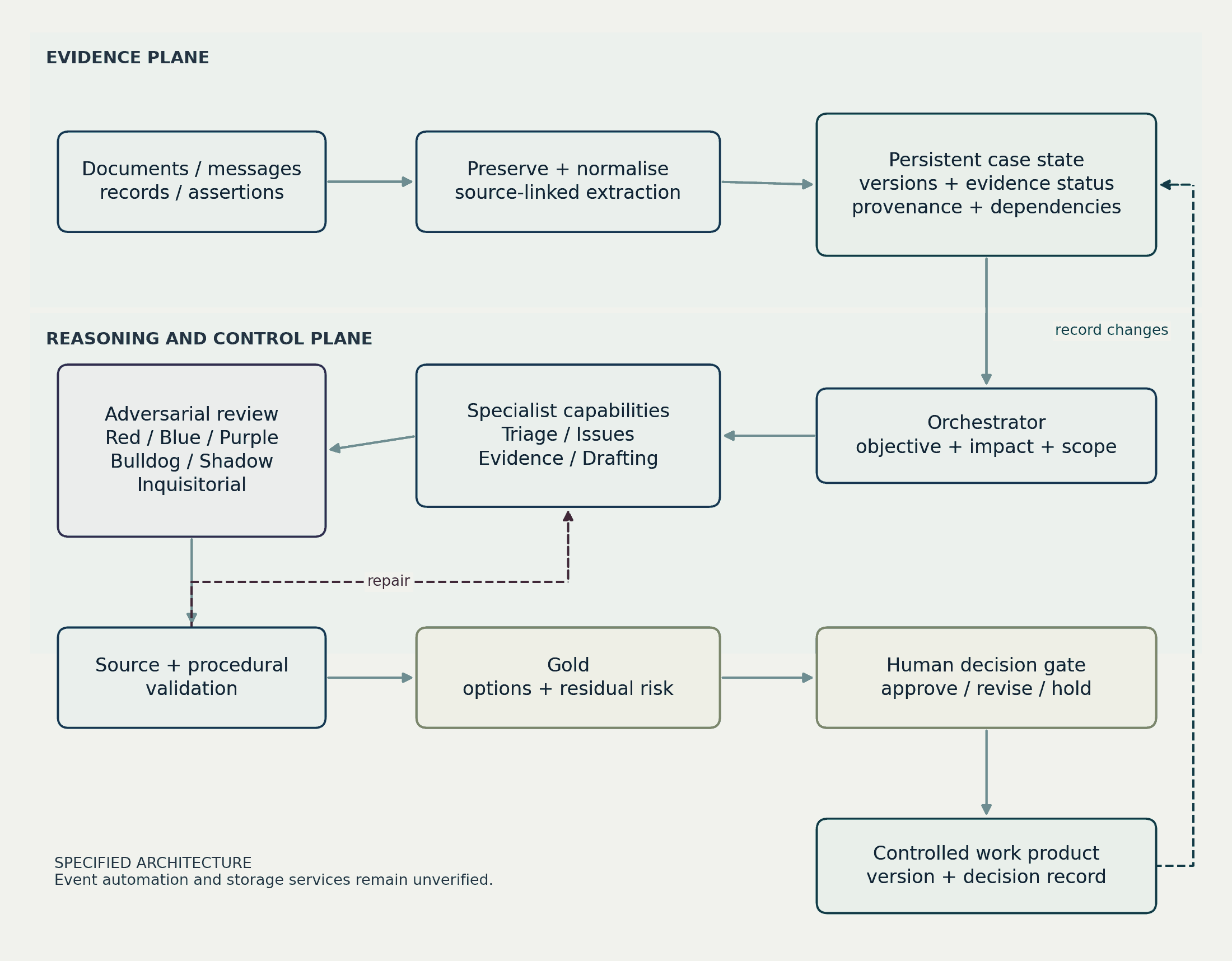
One case controller. Bounded specialists. Independent verification.
Disprove the first diagnosis; test wrong joins, missing records and alternative causes.
05 / PURPLEReconcile
Parent rebuilds the financial chronology and resolves material source conflicts.
06 / GOLDVerify
Independent evidence, policy and release-control check: pass, rework or escalate.
07 / HANDOFFHuman authority
Controlled recommendation; specialist routing and approval support; human financial execution.
Public-safe architecture reconstructed from the 15 October design specifications. This proposed worker topology is not represented as a deployed live configuration.
01 / TECHNICAL ARCHITECTURE
Evidence and authority are separate systems.
Source-specific read adapters supply an immutable evidence manifest. The parent maintains case identity, verified record joins, retrieval timestamps, contradiction registers, policy versions and a coherent decision state. The proposed design reserves arithmetic, status checks, idempotency and rule evaluation for deterministic operations rather than LLM improvisation.
Least-privilege source access and bounded worker contracts
Independent Red and Gold reviewers; Purple reconciliation in the parent
Separate read, recommendation, routing, approval and execution boundaries
Recoverable case state, explicit hold conditions and traceable evidence
02 / ENGINEERING METHODOLOGY
Investigate. Challenge. Reconcile. Verify.
Start with the allegation, establish canonical invoice and case identity, retrieve the authoritative record for each field, then test alternative explanations. Reconstruct contract-to-charge-to-settlement lineage before recommending a remedy. Each unsupported claim becomes a named evidence request, not an assumed fact.
Field-specific source authority and signed commercial terms
Invoice-level ledger, chronology and amount-delta reconstruction
Red challenge → Purple reconciliation → Gold release gate
Concise operator brief backed by an auditable investigation dossier
03 / IMPLEMENTATION HISTORY
Built, operated, reviewed and redesigned.
The October 14 export records an active ATHOS agent with a Slack-triggered AR investigation flow, multi-system evidence access, a human-review handoff and specialist connections to PORTHOS and ARAMIS. The October 15 engineering package then defines an expanded parent–worker architecture, bounded read-only specialists, independent reviewers and improved operational controls.
July 2026Workflow created; AR triage engineering begins
September 2026Agent activation and specialist workflow evolution
14 OctoberWorkflow configuration provides an implementation snapshot
15 October onwardDesign review, proposed subagents, Policy v2 patch and test plan
04 / TEST ENGINEERING
Controls specified as falsifiable tests.
A dedicated regression matrix and deployment-readiness checklist translate financial policy into expected outcomes. The suite targets authorization, valid intake, client identity, duplicates, approval thresholds, payment status, refund sequencing, bulk reconciliations, source ambiguity and safe termination.
Negative tests for unauthorized access and invalid intake
Boundary-value tests for approval tiers and exception routing
Duplicate and cross-client collision tests
Processing-state hard stops and human approval verification
Bulk prechecks, amount reconciliation and second-person closure gates
ATHOS / Investigation handoff
From case evidence to a reviewable recommendation.
In the ATHOS architecture design, specialist tasks return source references and findings. The case controller reconciles disputed findings and prepares the exact recommendation for human review.
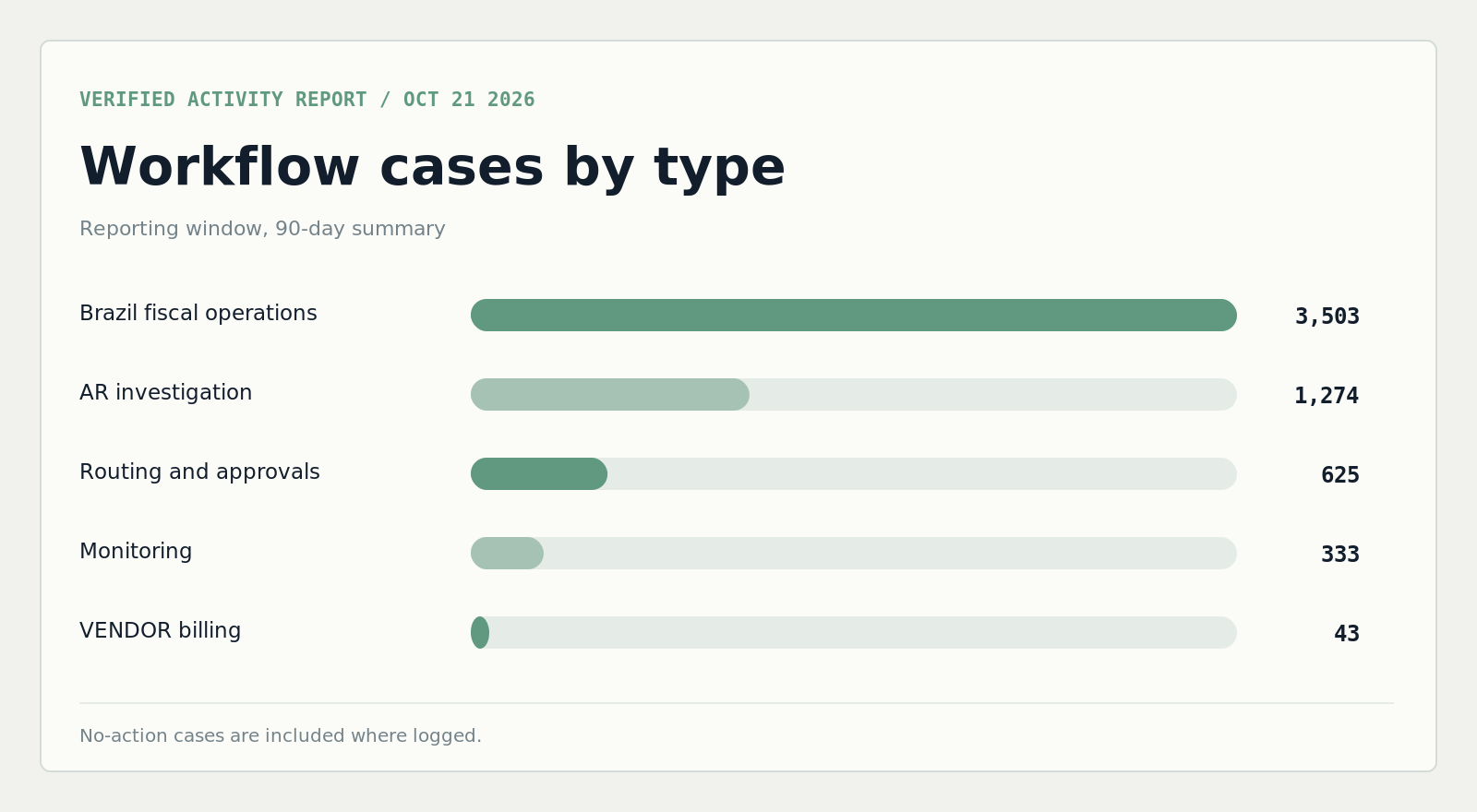
VISUAL EVIDENCE / CHARTS
Documented activity, shown visually.
Charts below are derived from the reviewed Akai work summary and are presented as operational telemetry, not personal labour saved.
My experience in billing, receivables and reconciliation informs how I design finance workflows. I map the records, team handoffs and decision rights behind each process.
My technical work covers agent orchestration, source verification, exception handling and human review.
A practical engineering toolchain for data analysis, agent workflows, financial validation and operational delivery.
SKILL EVIDENCE / CURRENT
PROGRAMMING / PRIMARY
Python
Applied · AI-assisted implementation
Typed request models, deterministic entity matching, validation, idempotency, test fixtures, spreadsheet processing, and document/PDF generation. AI-assisted implementation guided by defined architecture, test cases and release criteria.
SQL-based data extraction, reconciliation and financial analysis, supported by experience with Snowflake and Power BI modelling.
ReportingReconciliationData checks
STRUCTURED CONFIGURATION
JSON & YAML
Schema & configuration fluency
Agent inputs/outputs, typed configuration, rule maps and workflow state specifications. Schemas make required fields, validation rules and handoff expectations explicit.
PyYAMLSchemasValidationWorkflow state
WEB IMPLEMENTATION
HTML · CSS · JavaScript
AI-assisted portfolio delivery
Semantic HTML, responsive CSS and browser JavaScript support interactive project exploration, workflow visualisations and accessible navigation.
Context engineering · Agent decomposition · Model/rule separation · Deterministic validation · Structured state machines · API and tool contract design · Operational debugging · Human review gates · UAT and red-team testing · Auditable documentation · AI output verification.
02 / SELECTED WORK
Systems, not just prompts.
Selected enterprise workflow designs, production investigations, data reconciliations and independent evidence-system architectures. Client details and proprietary implementation material are omitted.
15CASE STUDIES
01 / AGENTSOperational lineage
ATHOS / AR Investigation
1,500 cumulative agent-session hours across the L1 triage lineage and separately tracked ATHOS workflow.
1,500h recorded runtime
02 / AGENTSOperational routing agent
PORTHOS / Workflow Router
707 hours of recorded agent activity supporting finance task routing and owner assignment.
707h recorded runtime
03 / AGENTSLive approval gates
ARAMIS / Approval Envoy
227 hours of recorded session activity in controlled credit-note approval preparation.
227h recorded runtime
04 / EVIDENCERecorded method
LEX AI / Evidence & decision architecture
Persistent evidence state, adversarial analysis and document-production controls.
Provenance
05 / GOVERNANCEInvestigated incident
Production AI / Incident reconstruction
Why an agent's explanation is not a reliable audit trail.
Root-cause forensics
06 / FINANCECompleted analytical reconciliation
Cross-entity reconciliation
Confidence-tiered matching without silently fabricating identity certainty.
Entity resolution
07 / AGENTSDeployed / iterated workflow
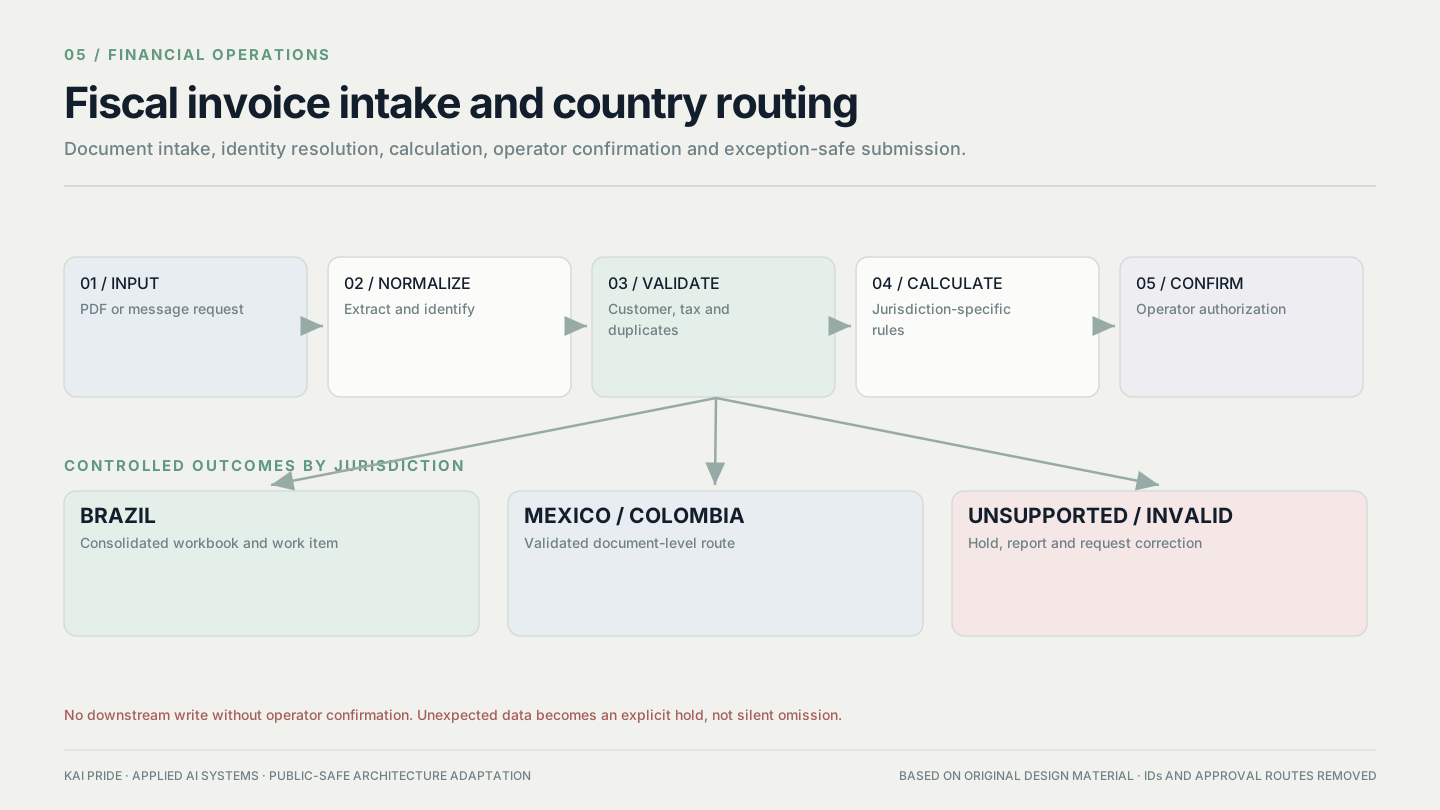
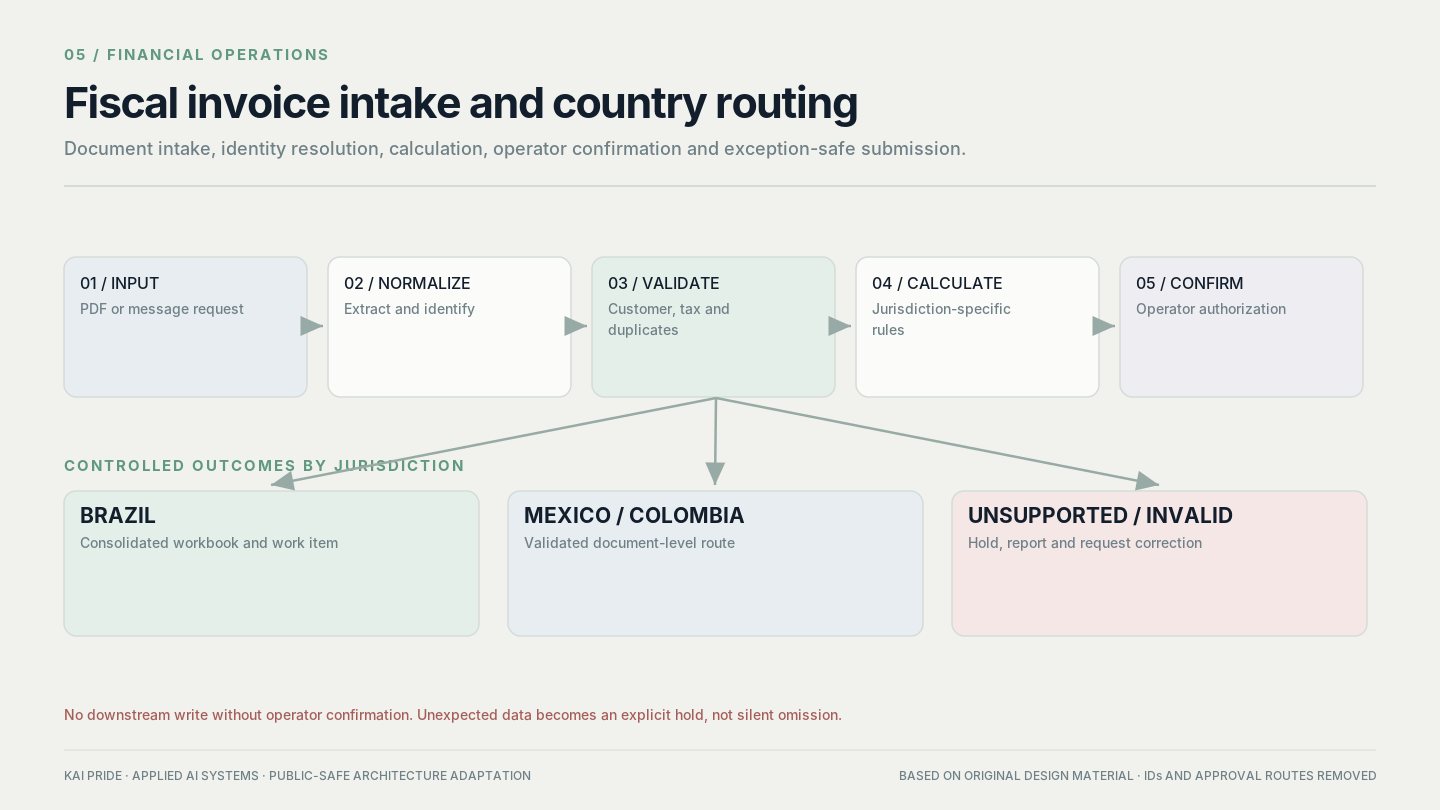
Brazil fiscal-invoice workflow
Thread-aware document intake, tax logic and controlled submission states.
Don't trust a pre-filled field just because it looks plausible.
Deterministic validation
09 / AGENTSPrototype / implementation blueprint
Slack-to-finance Python build pack
Typed records, identity matching, idempotency and staged release.
Python-assisted delivery
10 / AGENTSProduction workflow
VENDOR / Billing Automation Engine
Finance reconciliation, deterministic calculator and operational handoff.
Billing automation
11 / FINANCECompleted forensic analysis
Multi-country billing re-audit
Contract precedence, numeric anomalies and a reproducible audit method.
Contract analysis
12 / FINANCECompleted analytical reconciliation
Cash application decision system
Exact allocation first; currency-aware FIFO only when the rules allow it.
Cash application
13 / GOVERNANCEApplied design method
Workflow factory / Specification standard
A reusable method for building controlled agents from SOPs.
SOP conversion
14 / FINANCERecorded analytical investigation
Revenue integrity / Credit investigation
Separating legitimate commercial credit flows from anomalous financial movement.
Revenue integrity
15 / GOVERNANCEObserved technical review
Bank-file pricing / AI assurance review
Identifying rule-source defects and designing a read-only billing-integrity investigation.
Pricing validation
Evidence standard: Each case is classified as operational use, an observed investigation, a build pack or a reference design. A documented design is not presented as a deployed autonomous platform. Outcomes are stated only to the level supported by the reviewed material.
03 / INTERACTIVE DESIGN LAB
Inside the workflow.
Select a system to inspect a simplified, public-safe execution graph. Select any stage to see its role, source requirements and stop conditions. These are illustrative abstractions, not exported internal workflow specifications.
↗ ARCHITECTURE / V1
EXPLORE SYSTEMS
DESIGN RULE
Never let an AI-generated explanation substitute for verified system state.
SYS/001REFERENCE GRAPH
Investigation & decision architecture
SELECTED STAGE
Conceptual process visualization. No live company systems, client records or sensitive source materials are connected.
04 / INDEPENDENT SYSTEM DESIGN
LEX / AI
Evidence. Reasoning. Control.
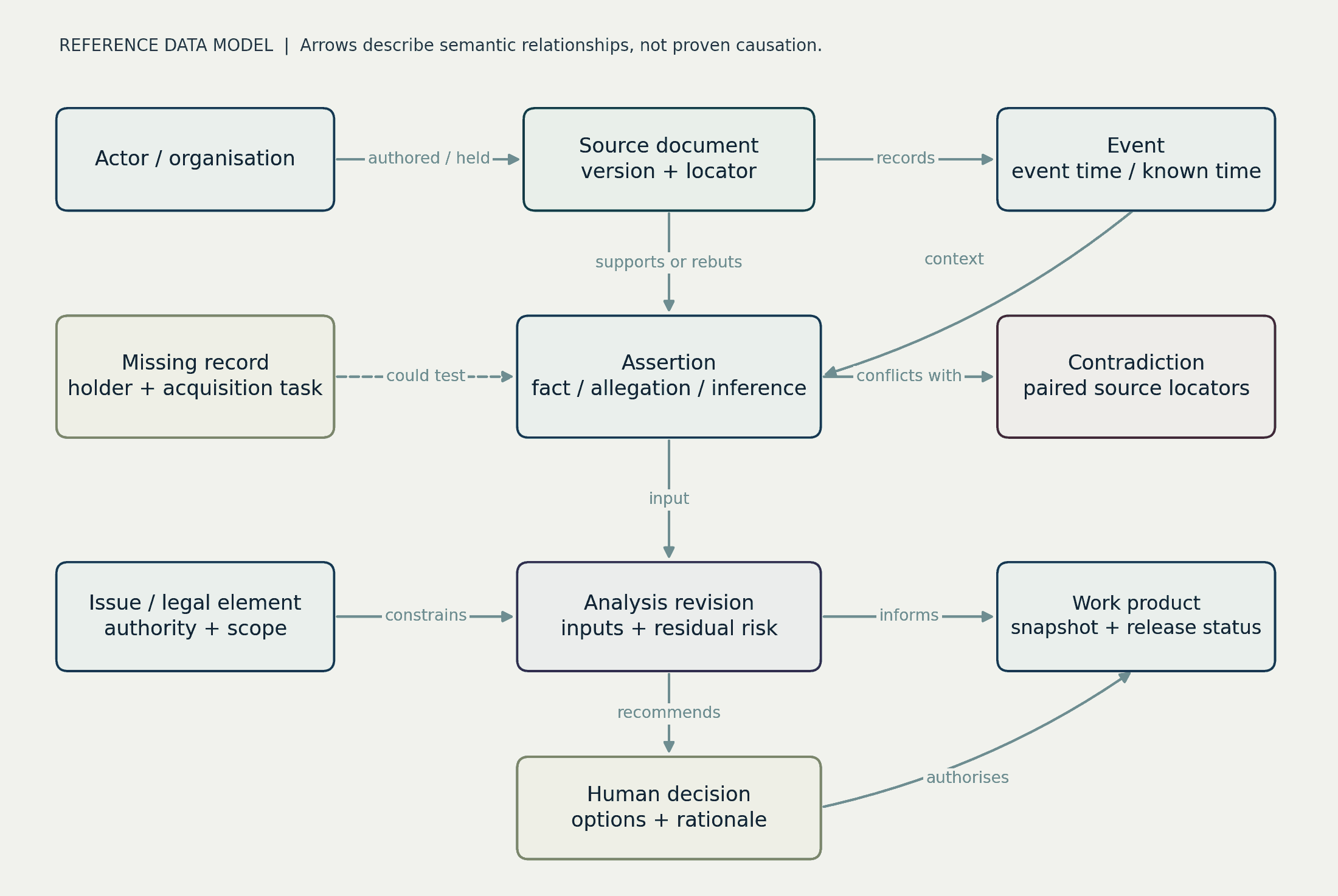
LEX AI is an evidence-centred architecture for keeping documents, factual propositions, competing interpretations and decisions aligned as a case evolves.
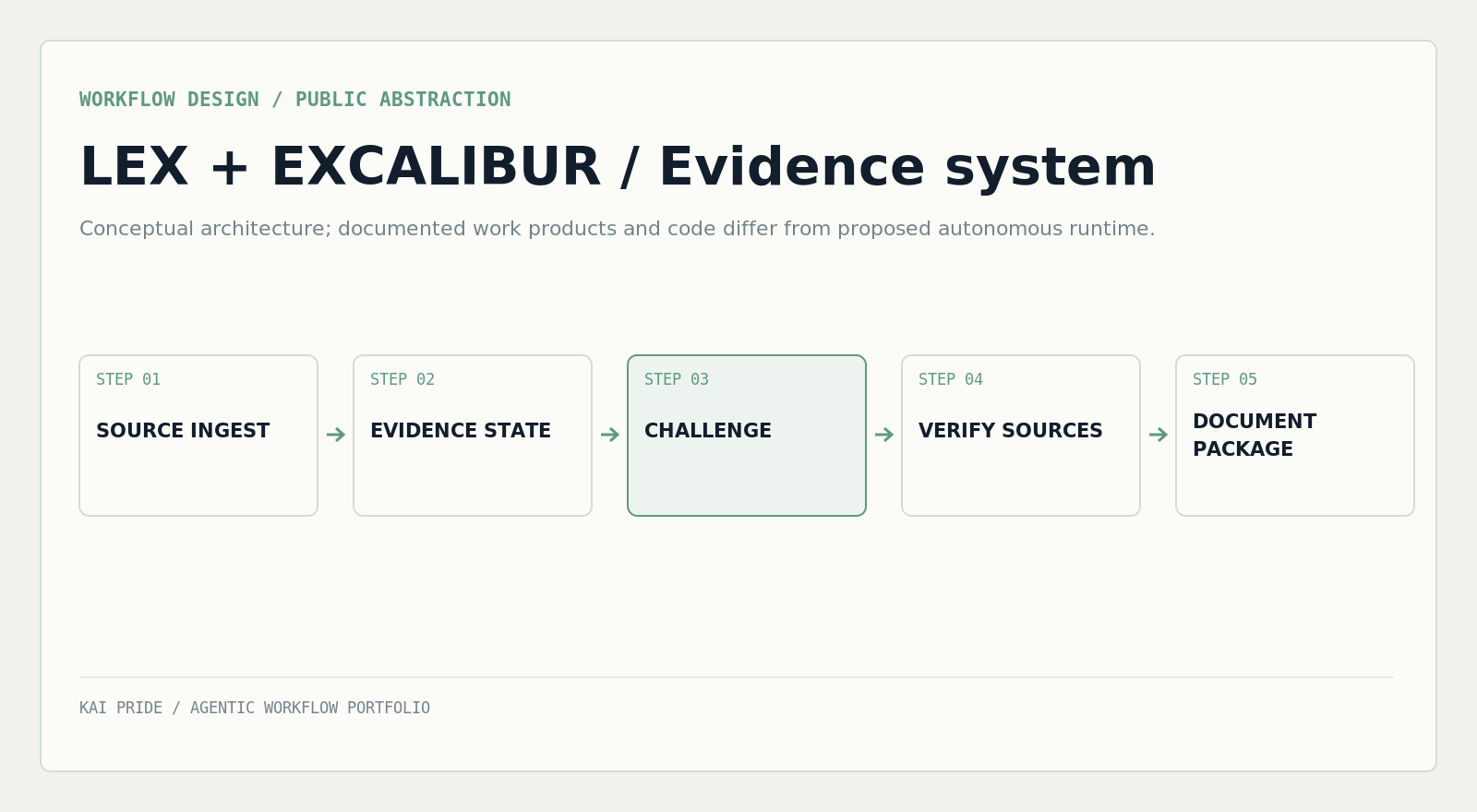
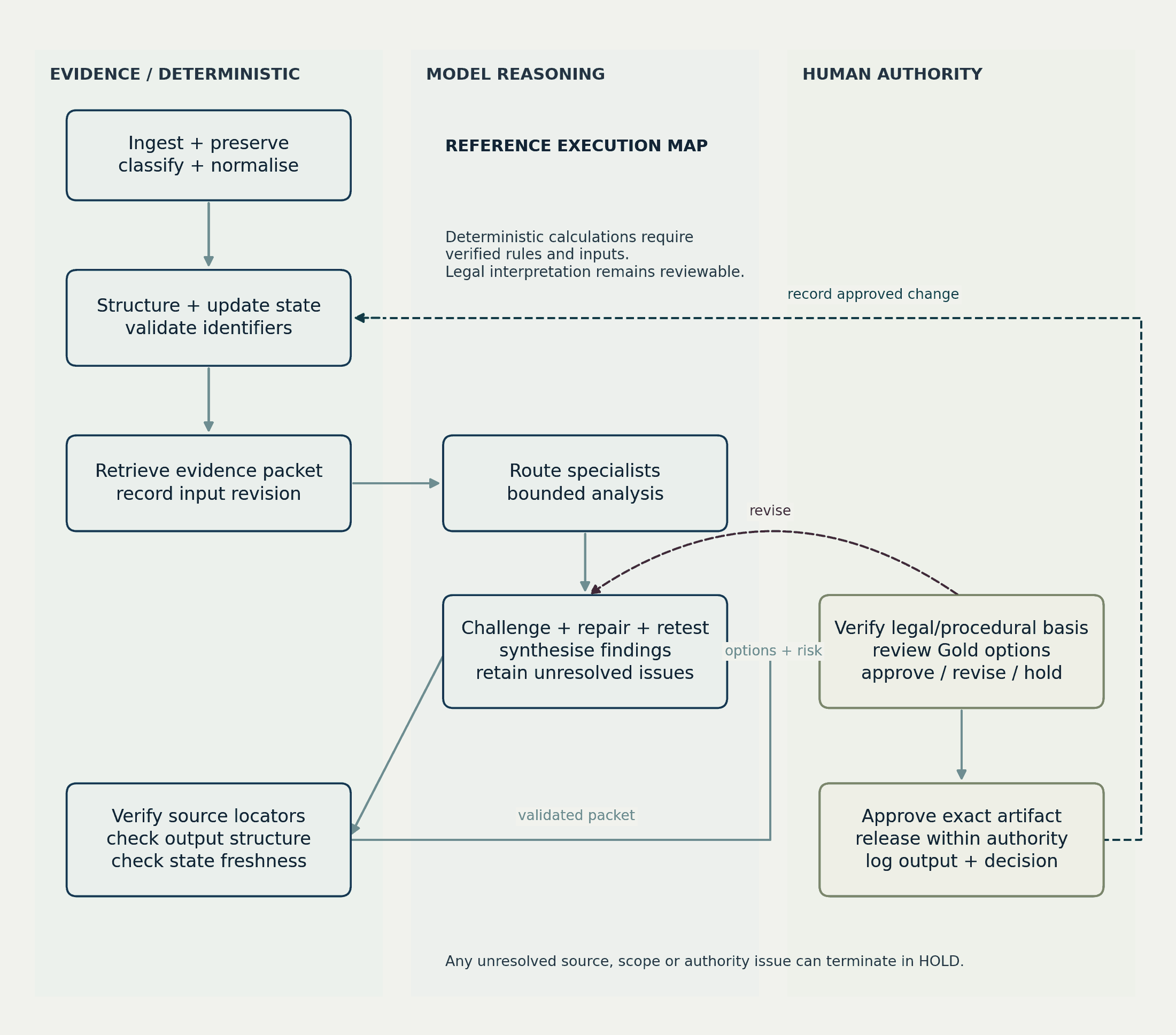
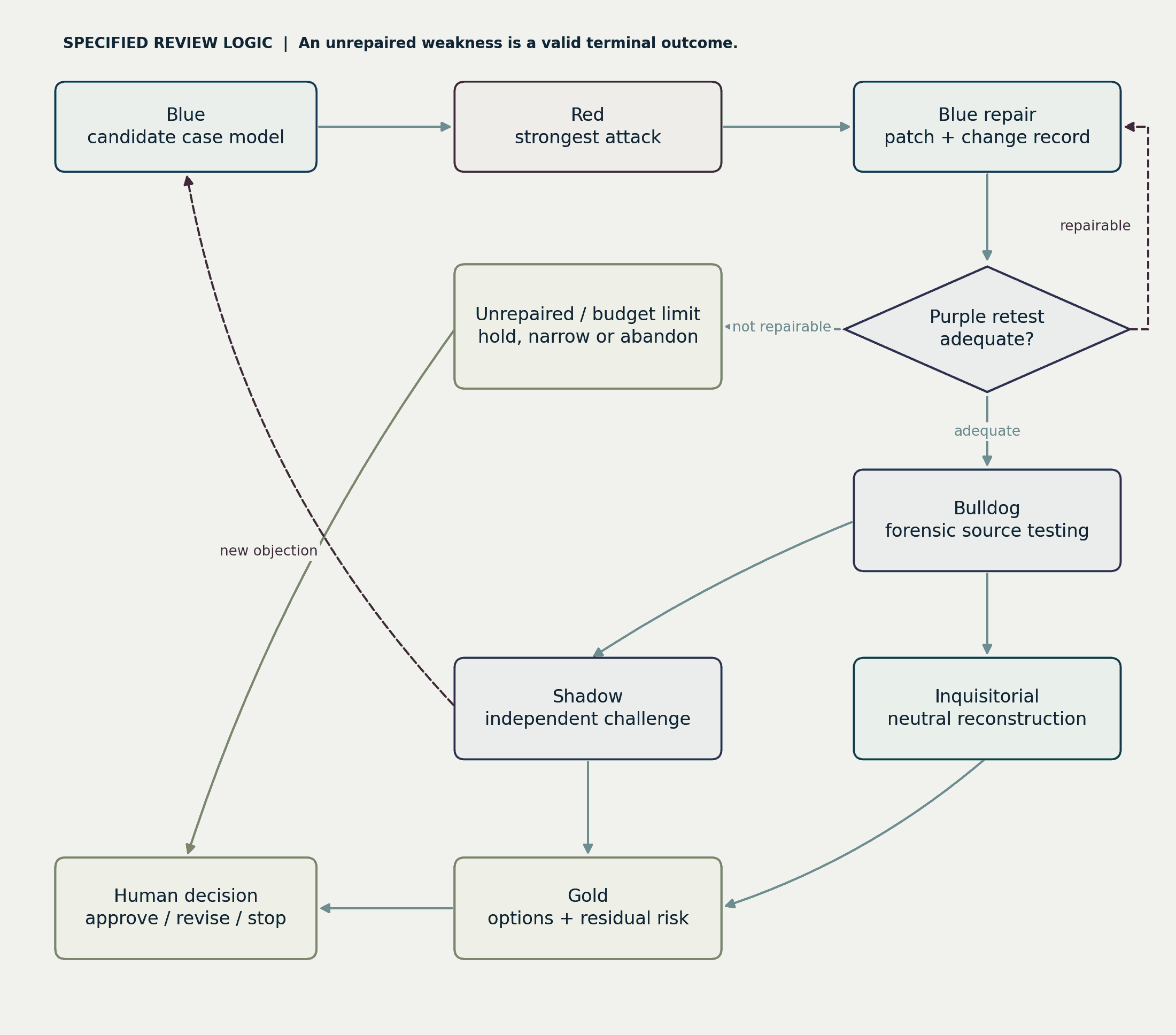
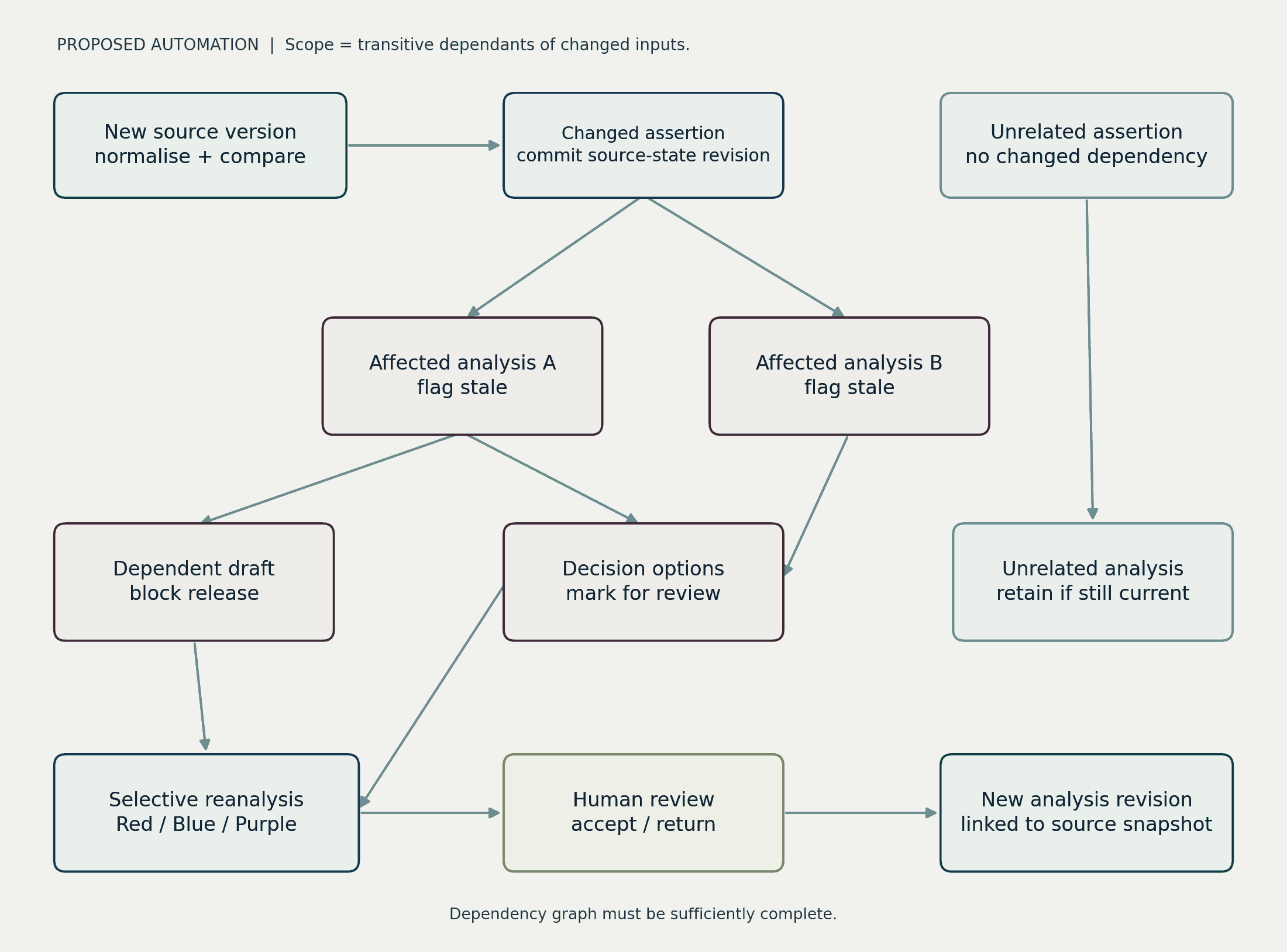
I developed the evidence-state method and specialist workflow specification: persistent chronology and contradiction records; bounded analysis; Red / Blue / Purple challenge; source-linked forensic checks; and human-controlled decisions. EXCALIBUR is the structured document-production workflow, with reviewed legal work products and Python-based assembly components.
 Meet
 Email
 Slack
 WhatsApp